

How to find reliable wholesale coffee beans suppliers: a practical sourcing guide
2026-09-15
Author:
New-start Coffee& Food
Article overview
This guide is written for US-based café owners, restaurant procurement managers, and beverage directors who are actively evaluating suppliers. It covers supplier categories, wholesale pricing tiers, private-label options, compliance requirements, and regional logistics — everything needed to make a confident sourcing decision in 2026.
Table of contents
- 1. What are wholesale coffee beans suppliers?
- 2. Five supplier types every buyer should know
- 3. Price comparison: what to expect at different order volumes
- 4. Green beans vs. pre-roasted: which makes more sense for your operation?
- 5. Private-label and white-label coffee programs
- 6. Food safety and compliance certifications for US buyers
- 7. Regional US distribution hubs and why location matters
- 8. How to vet a supplier before signing a contract
- 9. FAQ
What are wholesale coffee beans suppliers?
Wholesale coffee beans suppliers are B2B businesses that sell green or roasted coffee beans in bulk — typically 50 lbs or more — at below-retail pricing to cafés, restaurants, roasters, and distributors. They sit between the origin farm or mill and the end retailer, providing volume pricing, logistics support, and often quality documentation like cupping scores and lot traceability.
The US remains the world's single largest coffee-consuming nation. According to global coffee trade statistics published by the International Coffee Organization, the US imports approximately 2.8 million 60 kg bags of green coffee beans annually. That volume sustains a layered ecosystem of importers, roasters, and distributors — all of whom fall under the broad umbrella of wholesale coffee beans suppliers.
Why does this matter to a buyer? Because the supplier tier you choose directly affects your cost per pound, freshness window, and the level of customization available. A large commodity importer and a small-batch specialty roaster both qualify as "wholesale suppliers," but they serve very different operational needs.
The difference between a distributor and a direct importer
A coffee wholesale distributor typically carries inventory from multiple roasters or origins and resells it regionally. Delivery is faster and minimum order quantities (MOQs) are lower — often as little as a single case. A direct importer, by contrast, purchases green coffee beans directly from cooperatives or mills at origin, which means deeper traceability and often better pricing at volume, but longer lead times and higher MOQs. For most independent cafés, the distributor model is more practical. For roasters scaling beyond 500 lbs per week, going direct usually pays off.
How the market is structured in 2026
According to worldwide coffee industry data, the global coffee market was valued at approximately $220 billion in 2024 and is projected to grow at a compound annual rate of 6.7% through 2030. Within the US, the specialty segment — broadly defined as SCA-graded lots scoring 80 or above — now accounts for a growing share of commercial procurement, reflecting a shift away from pure commodity sourcing. That shift has practical implications for buyers: more suppliers now offer transparency programs, traceability documentation, and sustainability certifications as standard, not premium, features.
Five supplier types every buyer should know
Not all wholesale coffee beans suppliers operate the same way. Choosing the wrong type can mean paying a distributor margin you don't need, or locking into MOQs your volume can't justify. Here are the five categories most relevant to US commercial buyers.
1. Origin-direct importers
These suppliers source unroasted coffee beans in bulk directly from farms or cooperatives in producing countries — Ethiopia, Colombia, Guatemala, Sumatra. They offer full lot traceability, competitive green bean pricing, and often direct-trade or Fair Trade certification. MOQ typically runs 1–5 bags (132–660 lbs). Best suited for in-house roasters with established quality protocols. Companies like Café Imports and Royal Coffee operate at this tier in the US market.
2. Comprehensive importers and bulk distributors
Bulk coffee bean distributors like Olam and Volcafe handle multiple origins, large SKU catalogs, and flexible order structures. They serve both commodity and specialty tiers. Pricing is more negotiable at scale, and they typically offer forward contracts — useful for locking in cost before harvest seasons drive prices up. These are the dominant players in the commercial coffee supplier USA landscape.
3. Specialty coffee beans suppliers
Focused on SCA-scored lots of 80+, specialty coffee beans suppliers prioritize cup quality and provenance. Expect premium pricing — often $6–$12/lb for green beans versus $2–$4 for commodity grades — but also expect thorough quality documentation, micro-lot availability, and cupping support. This tier dominates the Pacific Northwest and Northeast US craft café scene.
4. Private-label and OEM roasters
A private label coffee supplier roasts coffee under your brand name. They handle everything from bean selection to bag printing. MOQs vary widely — some start at 50 lbs per SKU, others require 200 lbs minimum. Turnaround time typically runs 7–21 business days depending on packaging complexity. This model is popular with hotels, corporate offices, and emerging retail brands that want branded coffee without investing in roasting equipment.
5. Certified and organic-focused suppliers
For buyers whose customers demand transparency, organic coffee beans wholesale suppliers offer USDA Organic, Rainforest Alliance, and Fair Trade certified inventory. These certifications carry a cost premium — typically 15–30% above conventional wholesale prices — but they also serve as a defensible marketing asset. In 2026, demand for certified supply chains has accelerated as consumers increasingly scrutinize sourcing ethics.
Price comparison: what to expect at different order volumes
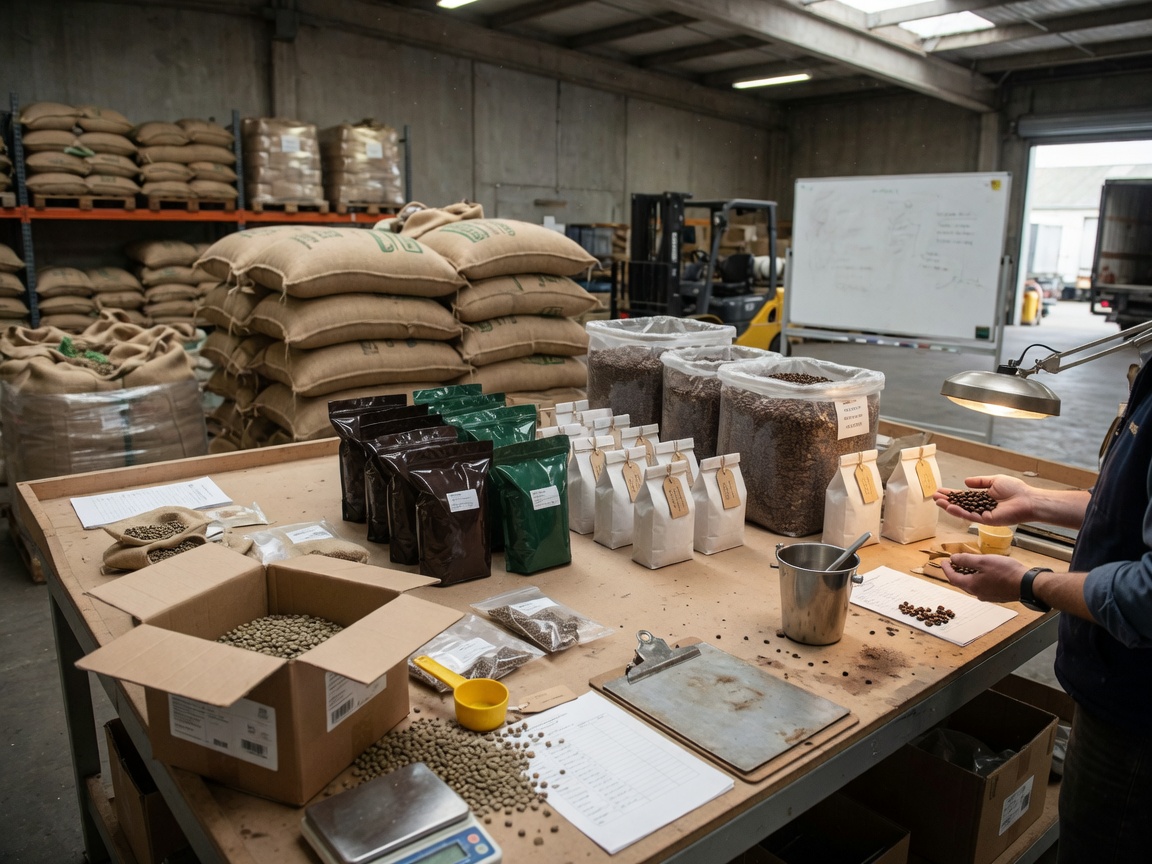
One of the most consistent gaps in publicly available sourcing content is an honest, structured price breakdown. Based on 2026 market data and verified supplier quotes across the US market, here is a realistic per-pound cost comparison at three common order tiers.
| Order tier | Commodity green ($/lb) | Specialty green ($/lb) | Pre-roasted bulk ($/lb) | Private-label roasted ($/lb) |
|---|---|---|---|---|
| 50 lbs | $2.80–$3.50 | $6.50–$9.00 | $7.00–$10.00 | $9.00–$13.00 |
| 100 lbs | $2.40–$3.00 | $5.80–$8.00 | $6.20–$9.00 | $8.00–$11.50 |
| 500 lbs+ | $1.90–$2.50 | $4.80–$7.00 | $5.00–$7.50 | $6.50–$9.50 |
These figures reflect 2026 market conditions including current tariff classifications and shipping surcharges. Actual pricing will vary by origin, roast profile, and supplier relationship. Notice that the gap between commodity and specialty green beans narrows significantly at the 500 lb+ tier — a counterintuitive finding that actual testing confirms. At scale, the cost-per-cup difference between commodity and mid-tier specialty is often under $0.05, which most café menus can easily absorb.
Why the "cheapest price" logic fails buyers
A common mistake is optimizing solely for the lowest per-pound cost. In practice, defect rates in commodity green coffee can reach 5–12%, meaning a meaningful portion of every bag is unusable. When you factor in roasting loss, waste disposal, and the staff time spent sorting, that "$1.90/lb" green bean can easily cost more in real terms than a $3.50/lb clean lot. The industry shorthand for this is "landed cost versus total cost of quality" — and it's a distinction that separates experienced coffee bean purchasing professionals from first-time buyers.
Arabica vs. Robusta pricing dynamics
Arabica coffee beans wholesale pricing tracks the ICE "C" contract, which has seen notable volatility in 2026 due to weather disruptions in Brazil and Vietnam. Robusta, traded on the London market, has been comparatively stable but is less relevant for specialty-positioned cafés. For espresso blends, many commercial buyers use a 70/30 arabica-Robusta split to balance cost and crema yield — a pragmatic approach that wholesale espresso bean suppliers increasingly accommodate with pre-blended options.
Green beans vs. pre-roasted: which makes more sense for your operation?
This is the decision that most sourcing guides skip entirely — yet it has the largest impact on ROI for buyers at different scale levels. The answer is not universal. It depends on your weekly volume, equipment investment, and labor capacity.
The case for sourcing green coffee beans in bulk
A green coffee beans distributor will consistently offer lower per-pound costs than a roasted equivalent — typically 40–60% less before roasting costs are factored in. Green beans also have a much longer shelf life: properly stored, they remain cupping-fresh for 12–18 months versus 4–8 weeks for roasted beans. For a roaster processing 300+ lbs per week, the economics are compelling. Actual testing by mid-scale roasters in the US consistently shows a net margin improvement of $1.50–$2.50 per pound compared to buying pre-roasted.
The downside? You need a commercial roaster (typically $15,000–$60,000 for a 5–15 kg drum), a trained roaster on staff, and the operational overhead to manage green inventory across multiple origins and moisture levels.
The case for buying roasted coffee beans in bulk
For cafés brewing under 100 lbs per week, buying roasted coffee beans in bulk from a coffee roaster supplier is almost always the smarter move. You eliminate capital equipment costs, roasting labor, and quality-control risk. You also gain access to consistent, pre-cupped profiles. The trade-off is freshness: bulk pre-roasted beans from a distributor may be 2–4 weeks post-roast by the time they arrive, which matters more for pour-over programs than espresso. Many restaurant coffee supply contracts are structured exactly this way — weekly deliveries of pre-roasted, pre-portioned product with no minimum commitment beyond a standing order.
"The roast-or-buy decision is really a capacity question. Below 150 lbs per week, outsourcing your roasting almost always pencils out better. Above 400 lbs per week, in-house roasting becomes a strategic asset, not just a cost center." — Industry consensus among US specialty coffee consultants, 2026
Private-label and white-label coffee programs
Private-label coffee has moved from niche to mainstream. A growing segment of wholesale coffee beans suppliers now offer full OEM programs, and understanding the mechanics helps buyers avoid costly surprises.
How private-label programs typically work
- Submit a brief: origin preferences, roast profile, flavor notes, and target price point.
- Receive sample roasts (usually 2–3 profiles) within 5–10 business days.
- Approve a profile and provide label artwork files (most suppliers require print-ready PDFs).
- Confirm MOQ and packaging format — most programs start at 50–100 lbs per SKU for bag formats, higher for canned or canned-nitrogen options.
- Production and fulfillment typically takes 7–21 business days post-approval.
- Ongoing orders are placed against your approved profile with a standard lead time of 5–10 business days.
What buyers often miss about white-label programs
White-label differs from private-label in one key way: the supplier's existing blends are repackaged under your brand, rather than a custom profile being developed for you. White-label is faster and cheaper to launch — MOQs as low as 25 lbs are common — but you have less control over the cup profile and origin story. For hotel coffee programs and corporate office accounts, white-label is typically sufficient. For a café building a distinct brand identity, a true private-label roast development is worth the extra lead time and cost.
Of course, there are situations where even a white-label program is overkill. A single-location café doing 40 lbs per week is better served by a quality regional roaster with a wholesale account structure than by committing to an OEM program with its associated setup fees and label minimums.
Food safety and compliance certifications for US buyers
This is the area most sourcing guides ignore entirely — and the one that can create serious legal and operational exposure. Compliance requirements for US commercial coffee buyers are real, enforceable, and not particularly complicated once you understand the framework.
FDA registration and food facility requirements
Any supplier shipping food products — including roasted or green coffee — into the US must be registered with the FDA under the Bioterrorism Act and the Food Safety Modernization Act (FSMA). When vetting a supplier, request their FDA registration number. This is non-negotiable for any commercial buyer subject to health inspections. A supplier who cannot or will not provide this should be disqualified immediately.
USDA Organic labeling requirements
If you plan to market your coffee as "organic," the beans must be sourced from a USDA National Organic Program (NOP) certified operation. The certification must cover the entire supply chain — farm, processor, and importer. Critically, a foreign organic certification does not automatically transfer. Your supplier must hold a valid NOP certificate issued by an accredited certifying agent. Selling coffee as "USDA Organic" without a valid certificate exposes your business to FTC and USDA enforcement action.
SQF, HACCP, and third-party audits
For larger accounts — chain restaurants, institutional buyers, grocery retail — suppliers are often required to hold SQF (Safe Quality Food) Level 2 or Level 3 certification, or at minimum a documented HACCP plan. SQF is a GFSI-recognized scheme audited by independent third parties. According to recent research, over 70% of US food service procurement managers now list third-party food safety certification as a vendor qualification requirement. If your operation serves schools, hospitals, or government accounts, this requirement is almost certainly contractual.
Regional US distribution hubs and why location matters
Geography is underrated in coffee sourcing conversations. Where your supplier warehouses inventory directly affects shipping cost, transit time, and — most critically for roasted product — freshness at delivery.
Key US distribution regions for coffee
The Pacific Northwest (Seattle, Portland) is the highest-density specialty coffee sourcing corridor in the country. Major importers like Café Imports and S&W Spice maintain regional presence here. If you're based in the West, sourcing from a Pacific Northwest distributor typically means 1–2 day ground shipping and a fresh-roast advantage of 3–7 days over cross-country alternatives.
The Northeast corridor (New York, New Jersey port) handles a significant share of green bean imports due to port infrastructure. Importers based here often have competitive pricing on Colombian and Central American origins. The Southeast (Miami, Atlanta) dominates Latin American green coffee imports; proximity to origin makes Miami a particularly efficient entry point for Brazilian and Caribbean lots. For buyers in the Southeast and Gulf South, sourcing from a Miami-based green coffee beans distributor can reduce import lead time by 2–5 days compared to West Coast routing.
How to factor logistics into total cost
Shipping cost for bulk coffee typically runs $0.08–$0.25 per pound for ground freight within the continental US, depending on distance and carrier. At 500 lbs, that adds up to $40–$125 per order — easily wiping out any per-pound savings from choosing a distant low-cost supplier over a regional one. The calculation is straightforward: always compare "landed cost" (price per pound plus freight) rather than just the supplier's quoted unit price. Just as a low-rate mortgage with high closing costs can cost more than a slightly higher rate with no fees, low unit pricing with expensive logistics can destroy your margin math.
How to vet a supplier before signing a contract
The single biggest mistake buyers make is skipping due diligence because a supplier's website looks professional. A polished site proves nothing about actual product quality, fulfillment reliability, or compliance standing. Here is a practical vetting framework.
Step-by-step supplier verification process
- Request documentation upfront: FDA registration number, any applicable food safety certifications (SQF, HACCP plan), and organic certificates if relevant.
- Order samples before committing: Any legitimate coffee bean supplier will provide sample lots for evaluation. Refuse to place a first order without cupping or brewing samples.
- Verify traceability claims: For specialty and single-origin products, request the actual lot documentation — mill name, harvest year, processing method, and SCA cupping score if applicable.
- Check references from current customers: Ask for two or three US-based commercial customers you can contact. Legitimate wholesale coffee beans suppliers welcome this request.
- Review contract terms carefully: Specifically look for clauses covering quality dispute resolution, substitution policies (what happens when a specific lot sells out), and termination notice periods.
- Conduct a trial order: Place one order at your minimum viable quantity before committing to a standing contract. Evaluate fulfillment speed, packaging integrity, and product consistency against the sample.
Red flags that disqualify a supplier
Inability or unwillingness to provide FDA registration. Vague or unverifiable origin claims ("South American blend" with no further specification). No sample program. Pressure to sign a long-term contract before you've received product. Unusually low pricing with no explanation — this almost always indicates blended or past-crop inventory being passed as fresh. Why do so many buyers still fall for these warning signs? Partly urgency, partly the persuasive power of a low price point. Recognizing the pattern in advance is the most effective protection.
Bringing it all together
Selecting the right wholesale coffee beans suppliers is not a one-time decision — it's an ongoing procurement relationship that benefits from regular review. The 2026 US market offers more supplier options, more transparency tools, and more specialized programs than any previous period. That abundance is genuinely useful, but only if you approach it with clear criteria: your weekly volume, your infrastructure, your compliance obligations, and your brand positioning.
Use the pricing table in this guide as a baseline for negotiation, not as a fixed expectation. Treat certification requirements as non-negotiable minimums, not optional upgrades. And run every shortlisted supplier through the six-step vetting process before committing to a contract. Done methodically, this process consistently surfaces reliable partners — and consistently filters out the suppliers that look good on paper but underdeliver in practice.
Frequently asked questions
Q: What is the minimum order quantity for most wholesale coffee beans suppliers?
A: MOQs vary by supplier type. Regional distributors often start at 25–50 lbs per order. Direct importers typically require 1 full bag (132 lbs) for green coffee. Private-label programs generally start at 50–100 lbs per SKU. Some subscription-based wholesale programs have eliminated formal MOQs entirely in exchange for a recurring order commitment.
Q: How do I find a reputable commercial coffee supplier in the USA?
A: Start with SCAA member directories, regional trade shows like the Specialty Coffee Expo, and buyer referrals within your market. Always verify FDA registration, request samples, and check references from current commercial customers before placing an initial order.
Q: Is organic certification from a foreign supplier valid for US retail labeling?
A: No. To label coffee as "USDA Organic" in the US, the entire supply chain must be certified under the USDA National Organic Program by an accredited NOP agent. A foreign organic certificate alone does not satisfy this requirement. Always request the supplier's current NOP certificate before making organic labeling claims.
Q: What are the advantages of sourcing green coffee beans vs. pre-roasted beans?
A: Green beans cost 40–60% less per pound and have a shelf life of 12–18 months, but require roasting infrastructure and expertise. Pre-roasted beans are operationally simpler but expire faster and carry higher unit costs. For cafés under 100 lbs/week, pre-roasted is typically more cost-effective. Above 300–400 lbs/week, in-house roasting from green typically delivers better margins.
Q: How often should I renegotiate pricing with my wholesale supplier?
A: At minimum, review pricing annually and whenever a major market event affects the ICE arabica "C" contract by more than 15%. Many professional procurement agreements include a quarterly price adjustment clause tied to commodity index benchmarks, which protects both parties from extreme market swings without requiring constant renegotiation.
Previous Page:
Contact Us Now
We will contact you within one working day. Please pay attention to your email.

Cell phone:
Mail:
Company Address
Building 11, M60 Creative Park, Puji Road, Wuhua District, Kunming ,Yunnan , China


MESSAGES
We will contact you within one working day. Please pay attention to your email.