

Morel mushroom guide: how to find, identify, and cook them safely
2026-10-16
Author:
New-start Coffee& Food
Article overview
This guide delivers a complete, field-tested reference for morel mushroom hunters, home cooks, and curious foragers. It covers identification, regional timing, safety warnings, cultivation, nutrition, sourcing, and recipes — all updated for 2026.
Table of contents
- 1. What is a morel mushroom?
- 2. Morel season by region: a 2026 timing guide
- 3. How to identify morel mushrooms (and spot dangerous fakes)
- 4. How to forage morel mushrooms safely
- 5. Morel mushroom nutrition and health benefits
- 6. How to grow morel mushrooms at home
- 7. Where to buy fresh and dried morel mushrooms online
- 8. Morel mushroom recipes: from pan to plate
- 9. FAQ
What is a morel mushroom?
A morel mushroom is a wild, edible fungus in the genus Morchella, recognized by its distinctive honeycomb-patterned cap and fully hollow interior stem. It ranks among the most sought-after spring mushrooms in North America, prized by chefs and foragers alike for its earthy, nutty flavor profile that intensifies dramatically when dried or sautéed in butter.
Taxonomically, morels belong to the phylum Ascomycota — making them true sac fungi rather than the gilled mushrooms most people picture. The genus Morchella contains roughly 80 accepted species worldwide, with the most commercially significant being M. esculenta (yellow morel), M. elata (black morel), and M. semilibera (half-free morel). For a deep dive into morel mushroom biology, the peer-reviewed literature indexed on Wikipedia's Morchella entry provides a solid taxonomic foundation.
Why does this distinction matter? Because knowing the genus helps you understand behavior. Morels are mycorrhizal or saprotrophic depending on species — meaning some grow in partnership with specific tree roots (elm, ash, apple), while others colonize decaying organic matter. That biological detail directly shapes where and when you look for them.
Key species at a glance
| Species | Common name | Cap color | Typical habitat | Flavor intensity |
|---|---|---|---|---|
| M. esculenta | Yellow morel | Tan to golden-brown | Elm, ash, dying hardwoods | Mild, nutty |
| M. elata | Black morel | Dark gray to black | Conifer forests, burn sites | Bold, smoky |
| M. semilibera | Half-free morel | Brown, cap partially detached | Riparian zones, mixed woods | Delicate |
| M. rufobrunnea | White morel | Pale cream to white | West Coast riparian, urban | Mild |
| Burn morel | Burn-site morel | Black to dark brown | Post-wildfire forests | Intense, complex |
Market context in 2026
The global morel mushroom market was valued at approximately $1.1 billion in recent years and is projected to grow at a CAGR exceeding 9% through 2030, according to Grand View Research. In the U.S. retail market, fresh morels typically sell for $30–$60 per pound, while premium dried morel mushrooms can command $150–$300 per pound. The 2026 landscape is shifting, however — commercial cultivation at scale in China's Sichuan and Yunnan provinces is gradually increasing supply and moderating historically extreme price spikes.
Morel season by region: a 2026 timing guide
Morel season follows soil temperature more than the calendar — mushrooms typically fruit when ground temperatures reach 45–55°F (7–13°C) at a 2-inch depth. That means the season begins in the Deep South in late February and doesn't peak in northern states or high elevations until late May or June.
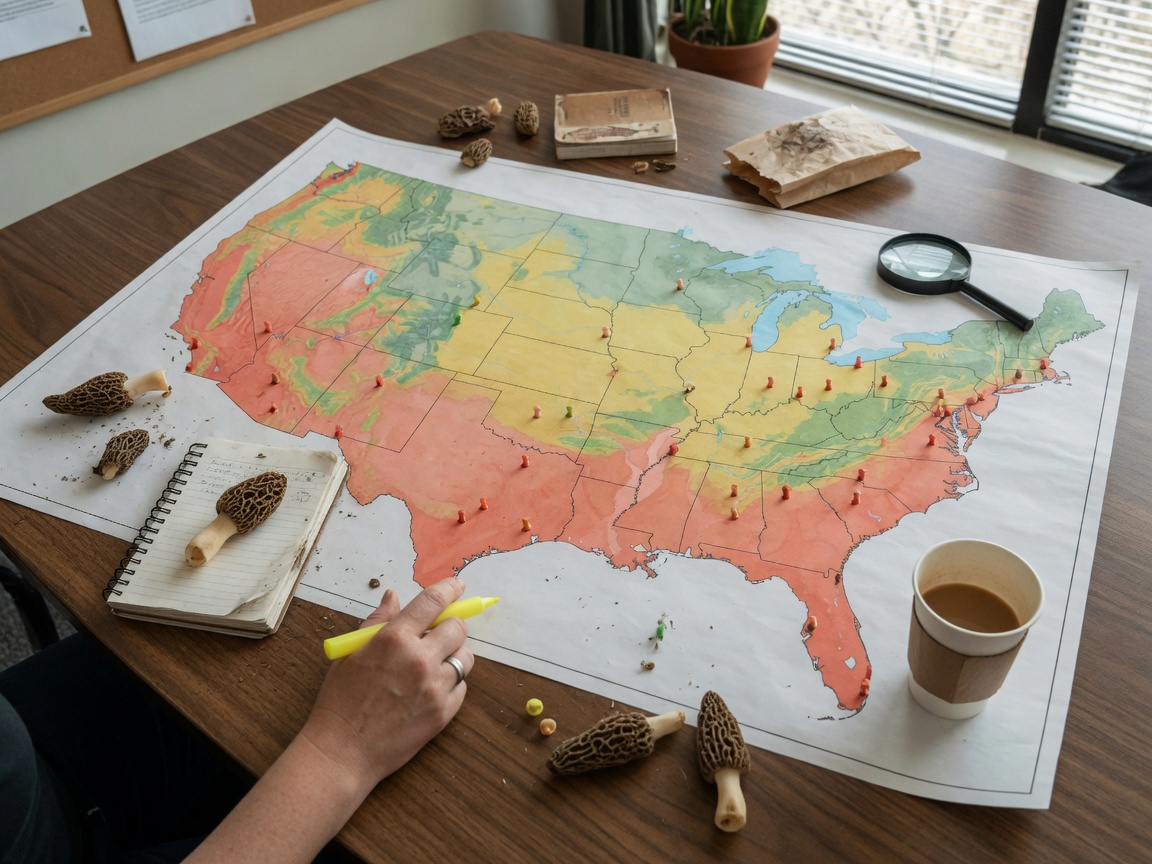
Region-by-region morel timing
Gulf Coast and Deep South (Alabama, Mississippi, Arkansas): Late February through mid-March. Black morels often appear first around dying elms. The window is narrow — sometimes just 10–14 days.
Midwest (Missouri, Illinois, Indiana, Iowa, Ohio): The heartland of American morel hunting. Peak season runs mid-April through mid-May, historically coinciding with blooming redbud and dogwood trees. Missouri is widely regarded as the most productive morel state per forager capita. Practical experience from multiple seasons confirms that the best Midwest finds cluster around old apple orchards and recently dead elm stands.
Appalachian range (West Virginia, Kentucky, Tennessee, western Pennsylvania): Mid-April to late May at lower elevations; push into June above 2,500 feet. The terrain complexity creates micro-season pockets that experienced hunters exploit by moving up in elevation as lower spots fade.
Great Lakes region (Michigan, Wisconsin, Minnesota): Late April through late May. Michigan's Upper Peninsula is legendary — some foragers drive hours to reach prime public land spots that produce reliably year after year.
Pacific Northwest (Oregon, Washington): Two distinct seasons occur here. A low-elevation spring flush runs March through April. A second, more dramatic burn morel season follows summer wildfires at elevation, often peaking in July–August. Oregon's post-fire landscapes have become a major draw for serious morel foraging expeditions.
Rocky Mountain states (Montana, Idaho, Colorado): Late May through July depending on elevation. Burn morels dominate here. After the record wildfire seasons of recent years, 2026 burn-site morel hunting in this region is attracting unprecedented interest from commercial pickers and weekend foragers alike.
The two-week window problem
Why do so many people miss morel season entirely? The average productive window at any single location spans just 2–4 weeks, and weather variability can compress it further. A late frost can kill an emerging flush overnight. Conversely, a rapid warm spell can push mushrooms from pin stage to over-mature in 72 hours. Checking soil temperature daily — using an inexpensive probe thermometer — is the single most reliable way to catch the season at its peak.
How to identify morel mushrooms (and spot dangerous fakes)
Accurate morel identification is non-negotiable. The consequences of misidentification can range from gastrointestinal distress to serious liver damage. True morels have three definitive structural features that, together, eliminate virtually all toxic look-alikes.
Three rules for true morel identification
- The cap is fully pitted and ridged in a honeycomb pattern — not smooth, wrinkled, or saddle-shaped. Pits are true indentations, not surface texture.
- The interior is completely hollow from the base of the stem straight through to the apex of the cap. Slice it longitudinally: one continuous hollow chamber, no cottony fill, no partial chambers.
- The cap is fully attached to the stem at its base. Lift the skirt of the cap — it should connect directly, not hang free like an overskirt.
All three must be present. If even one is absent, do not eat it.
False morel warning: Gyromitra esculenta and related species
The false morel — primarily Gyromitra esculenta and related Gyromitra species — is responsible for the majority of serious morel-related poisoning cases in North America and Europe. It contains gyromitrin, a compound that metabolizes into monomethylhydrazine (MMH), a potent liver and kidney toxin also found in rocket fuel. Symptoms of Gyromitra poisoning can be delayed 6–12 hours, making early medical intervention difficult.
"Gyromitrin toxicity is particularly dangerous because cooking does not reliably destroy the toxin — and even inhaling steam from boiling Gyromitra specimens has been linked to adverse health effects. No visual inspection method is 100% reliable; when in doubt, discard the specimen." — North American Mycological Association (NAMA) safety guidelines
Key visual differences between a true morel and a false morel:
| Feature | True morel (Morchella) | False morel (Gyromitra) |
|---|---|---|
| Cap texture | Deep honeycomb pits and ridges | Brain-like folds, lobes, or saddle shape |
| Interior | Fully hollow, single chamber | Partially hollow or cottony-filled |
| Cap attachment | Attached at stem base | Often free-hanging or lobed |
| Color range | Tan, gray, brown, black | Reddish-brown, irregular |
| Toxicity | Safe when fully cooked | Toxic; potentially lethal |
For a comprehensive visual reference and identification checklist, the University of Minnesota Extension's resource on morel mushroom identification is one of the most rigorously vetted public guides available.
How to forage morel mushrooms safely
Successful morel foraging combines ecological knowledge with practical field discipline. Knowing where morels grow is only half the equation — getting them home safely and legally requires deliberate preparation.
Where to look: habitat cues
Experienced foragers target dying or recently dead elms as a primary search pattern across the Midwest and East. Apple orchards — particularly abandoned ones — are reliably productive because of the mycorrhizal relationship between morels and aging apple root systems. Post-wildfire terrain produces spectacular burn morel flushes, sometimes measured in pounds per square foot in peak years. South-facing slopes warm faster and fruit earliest in spring; north-facing slopes retain moisture longer and fruit later, extending your effective season.
Foraging field checklist
- Verify land access permissions — National Forest land generally allows personal-use harvest; many state parks prohibit it entirely.
- Carry a mesh bag or wicker basket; mesh allows spore dispersal as you walk, supporting future flushes.
- Bring a reference guide and, ideally, forage with an experienced mentor on your first outings.
- Cut the specimen at the base rather than pulling — reduces mycelium disturbance.
- Never consume a wild mushroom in the field; always conduct a final identification check at home in good lighting.
- Cook all morels thoroughly; raw morels contain hemolytic proteins that break down only under sustained heat above 140°F (60°C).
The USDA Forest Service maintains guidance on foraging morel mushrooms on federal land, including permit requirements for commercial harvest that vary by forest district.
Morel mushroom nutrition and health benefits
Morel mushrooms deliver a compelling nutritional profile relative to their calorie density. According to USDA FoodData Central data, 100 grams of raw morel mushrooms contain approximately 31 calories, 3.1 g of protein, 0.6 g of fat, and 5.1 g of carbohydrates — making them one of the highest-protein edible mushrooms by dry-weight ratio.
Key nutrients per 100 g (raw morels, USDA data)
Morels are particularly notable for their iron content — approximately 12.2 mg per 100 g, which exceeds many red meats on a per-calorie basis. They also provide meaningful quantities of vitamin D (when exposed to sunlight, as with most wild mushrooms), copper (5.9 mg), manganese, and zinc. Their beta-glucan polysaccharide content has drawn increasing research interest for potential immune-modulating properties, though clinical evidence in humans remains preliminary as of 2026.
One important caveat
Raw morels contain thermolabile hemolysins — compounds that disrupt red blood cell membranes. These break down completely with thorough cooking. This is not a theoretical risk: documented cases of morel poisoning in North America consistently involve raw or insufficiently cooked specimens. Even lightly sautéed morels may not reach sufficient internal temperature throughout. The industry consensus is clear: cook morels fully, every time, with no exceptions.
How to grow morel mushrooms at home
Home cultivation of morels is one of the fastest-growing search intents in the mushroom space — and one that most existing guides completely fail to address in practical depth. The honest upfront answer: morels are significantly harder to cultivate than oyster or shiitake mushrooms, but it is achievable with the right method and realistic expectations.
The outdoor bed method (most reliable for home growers)
- Site selection: Choose a shaded or semi-shaded outdoor bed, ideally near a hardwood tree (elm, apple, or ash). Avoid direct full sun.
- Substrate preparation: Mix wood chips, composted hardwood bark, and a small quantity of wood ash. A slightly alkaline pH of 7.0–7.5 is optimal.
- Spawn inoculation: Introduce morel spawn (available from specialty suppliers) in fall, mixing it into the top 2–4 inches of the prepared bed. Water thoroughly.
- Sclerotia formation: Over winter, the mycelium develops sclerotia — nutrient storage bodies critical to fruiting. Do not disturb the bed.
- Spring "shock" treatment: In early spring, water the bed heavily with cold water to simulate snowmelt. This temperature differential triggers fruiting.
- Patience and monitoring: Fruiting may not occur in year one. Many growers report their first significant flush in year two or three. Consistent moisture management is essential.
Commercial-scale operations in China's Shangri-La region, situated at elevations around 2,000 meters, have demonstrated that using small arched cultivation sheds irrigated with mountain spring water and planted in humus-rich soil — with natural mountain breezes providing ventilation — closely replicates wild conditions. The longer growth cycles at high altitude allow morels to accumulate a richer nutrient and flavor profile. This approach is informing next-generation home cultivation kit designs now entering the U.S. market in 2026.
Indoor cultivation: current limitations
Fully indoor morel cultivation remains commercially unproven at consistent scale in the U.S. as of 2026. Several academic research programs — including work at Michigan State and Oregon State — are making incremental progress. The core challenge is replicating the winter dormancy and spring temperature differential that triggers sclerotia to produce fruiting bodies. Of course, hobbyists have occasionally succeeded indoors using refrigerator cold-shocking cycles, but results are highly inconsistent and not reproducible enough to recommend as a primary method.
Where to buy fresh and dried morel mushrooms online
Not everyone has access to productive foraging grounds or lives in a region with a reliable morel season. The good news: the U.S. online market for fresh and dried morel mushrooms has matured considerably, with several dependable sourcing options available in 2026.
Price benchmarks and buying guide
| Product type | Typical price range (US) | Best sourcing channel | Quality indicators |
|---|---|---|---|
| Fresh morels (in-season) | $30–$60/lb | Local farmers markets, specialty grocers (Whole Foods, Erewhon) | Firm texture, no slime, earthy aroma |
| Dried morels (whole) | $150–$300/lb ($10–$20/oz) | Marx Foods, Earthy Delights, Amazon specialty sellers | Deep color, intact caps, strong aroma |
| Dried morels (broken/pieces) | $80–$130/lb ($5–$9/oz) | Same as above; ideal for soups and sauces | Good value for cooking applications |
| Frozen morels | $25–$45/lb | Specialty online retailers, restaurant supply | IQF (individually quick frozen), no ice crystals |
When buying dried morel mushrooms online, check for country of origin. Wild-harvested U.S. morels command a premium and are typically labeled accordingly. Chinese cultivated morels are increasingly available at lower price points and deliver consistent flavor — a reasonable choice for everyday cooking. Avoid any product listing that cannot confirm whether mushrooms are whole-body or adulterated with stem fragments and debris.
Storage after purchase
Fresh morels should be refrigerated in a paper bag (not plastic) and used within 3–5 days. Dried morels keep in an airtight container in a cool, dark pantry for 12–18 months without significant flavor loss. Reconstitute in warm water for 20 minutes; the soaking liquid is deeply flavorful and should be strained and used in sauces.
Morel mushroom recipes: from pan to plate
Morel mushroom recipes succeed when they respect one principle: the mushroom is the main event. Think of morels the way a great steakhouse thinks of a prime dry-aged cut — your job as the cook is to enhance and not overshadow.
Classic sautéed morels (base technique)
Slice morels lengthwise and inspect the interior for insects — a common reality with wild specimens. Heat a cast-iron skillet over medium-high heat, add 2 tablespoons of unsalted butter, and wait for the foam to subside. Add morels in a single layer — crowding causes steaming rather than browning, which kills flavor development. Sauté 4–5 minutes without moving, flip, add a minced shallot and fresh thyme, cook another 3 minutes. Deglaze with a splash of dry sherry or white wine. Season with kosher salt at the end, never at the start, to avoid drawing out moisture prematurely.
Three high-impact applications
Morel cream sauce for pasta: Extend the sauté above with ½ cup heavy cream, reduce until nappant, toss with fresh pappardelle. A dish that routinely earns $28–$35 on fine dining menus — achievable at home for under $12 using dried morels.
Morel-stuffed chicken breast: Combine sautéed morels with cream cheese, fresh tarragon, and lemon zest. Stuff under the skin of bone-in chicken breasts before roasting at 375°F for 38–42 minutes. The fat from the skin bastes the stuffing, creating a self-saucing result.
Morel risotto: Build a standard Carnaroli or Arborio risotto, add reconstituted dried morels and their strained soaking liquid as part of your stock. Finish with Parmigiano-Reggiano and a drizzle of truffle oil. The earthy depth from the morel soaking liquid transforms an ordinary risotto into something genuinely remarkable.
Frequently asked questions
Q: When is morel mushroom season in the United States?
A: Morel season runs from late February in the Deep South through early July at high elevations in the Rockies. The Midwest peak — the most productive window nationally — typically falls between mid-April and mid-May. Exact timing depends on soil temperatures reaching 45–55°F at a 2-inch depth, which varies significantly by latitude and elevation each year.
Q: How do I tell a true morel from a false morel?
A: True morels have a deeply pitted honeycomb cap, are fully hollow inside from cap apex to stem base, and have their cap attached directly to the stem. False morels (Gyromitra species) have wrinkled or brain-like caps, are only partially hollow or contain cottony material, and may have caps that hang free. If any one of the three true morel criteria is absent, do not eat the specimen.
Q: Can you eat morel mushrooms raw?
A: No. Raw morel mushrooms contain hemolytic proteins that can cause gastrointestinal distress and, in larger quantities, more serious harm. These compounds break down completely with thorough cooking. Always cook morels fully — sautéing, roasting, or simmering for at least 5–7 minutes at temperatures above 140°F is the standard safety threshold recognized by food safety authorities.
Q: How much do morel mushrooms cost?
A: Fresh morels retail for approximately $30–$60 per pound in the U.S. during peak season. Dried whole morel mushrooms typically range from $150–$300 per pound ($10–$20 per ounce) from reputable online suppliers. Broken pieces are available for $80–$130 per pound and are well-suited for soups, sauces, and risottos where visual presentation is less critical.
Q: Is it possible to grow morel mushrooms at home?
A: Yes, though it requires patience. The outdoor bed method — using hardwood chip substrate near a compatible host tree, inoculated with morel spawn in fall and cold-shocked in spring — is the most reliable approach for home growers. Results may not appear until year two or three. Fully indoor cultivation remains technically challenging and inconsistent as of 2026, though research progress is ongoing.
The morel mushroom remains one of nature's most rewarding seasonal finds — and, with the right knowledge, one of the most accessible. Whether your goal is a successful morning in the woods, a safer identification technique, a home cultivation project, or simply the best morel risotto you have ever made, the fundamentals covered in this guide give you a credible, evidence-based foundation. Start with identification. Build your regional season awareness. Then let the rest follow naturally — just as morels do, each spring, when the soil finally warms.
Contact Us Now
We will contact you within one working day. Please pay attention to your email.

Cell phone:
Mail:
Company Address
Building 11, M60 Creative Park, Puji Road, Wuhua District, Kunming ,Yunnan , China


MESSAGES
We will contact you within one working day. Please pay attention to your email.