

Morel mushrooms: a complete foraging and cooking guide for beginners
2026-10-15
Author:
New-start Coffee& Food
Article overview
This guide provides a comprehensive, research-backed look at morel mushrooms — covering identification, foraging, preservation, pricing, cultivation, and cooking. Designed for beginners and intermediate foragers in the US market, it prioritizes safety and accuracy above all.
Table of contents
- 1. What are morel mushrooms?
- 2. How to identify morel mushrooms (and avoid false morels)
- 3. State-by-state morel season calendar
- 4. Where to find morels: habitat and foraging tips
- 5. How to preserve morels: drying, freezing, and more
- 6. Morel mushroom price guide (2026)
- 7. How to grow morels at home
- 8. Morel recipes: from simple sauté to gourmet dishes
- 9. FAQ
What are morel mushrooms?
Morel mushrooms are wild, honeycomb-capped edible fungi belonging to the genus Morchella, prized for their rich, nutty flavor and distinctive pitted appearance. They are classified as edible fungi within the Ascomycota phylum — meaning they reproduce via spores released from microscopic sacs, not gills. This structural distinction separates them from common grocery-store mushrooms.
Why do so many food enthusiasts obsess over them? The answer is texture and depth of flavor. No cultivated mushroom replicates the earthy, almost smoky complexity of a freshly foraged morel. Morel mushrooms have been harvested by Indigenous communities across North America for centuries, and professional chefs still pay a premium to source them every spring.
According to 2026 market data, the global morel mushroom industry is valued at over $600 million and growing at a CAGR of roughly 8.3%, driven by demand from fine dining, specialty retail, and the expanding home cooking movement.
The main species of morel mushrooms
Not all morels are identical. The genus Morchella includes several distinct species, each with its own flavor profile and geographic preference. Yellow morels (M. esculenta) are the most commercially significant, offering a mild, buttery taste. Black morels (M. elata) carry a more intense, woodsy flavor — highly sought after by chefs. The fire morel (M. tomentosa), found only in North American post-burn zones, is rarer still.
Why morels are considered a luxury ingredient
The short harvest window — typically just two to three weeks per location — makes consistent supply almost impossible. Add in the difficulty of cultivation and the perishability of fresh specimens, and you have a fungus that commands $30–$60 per pound fresh at retail. Dried morels can exceed $200 per pound at specialty stores. This scarcity, combined with extraordinary flavor, is what places them firmly in luxury ingredient territory alongside truffles and matsutake.
How to identify morel mushrooms (and avoid false morels)
Accurate morel identification is the single most important skill any forager must develop — because the consequences of error are serious. True morels are safe to eat when cooked; their lookalikes, particularly the Gyromitra species, can cause liver failure and death.
Key visual features of true morels
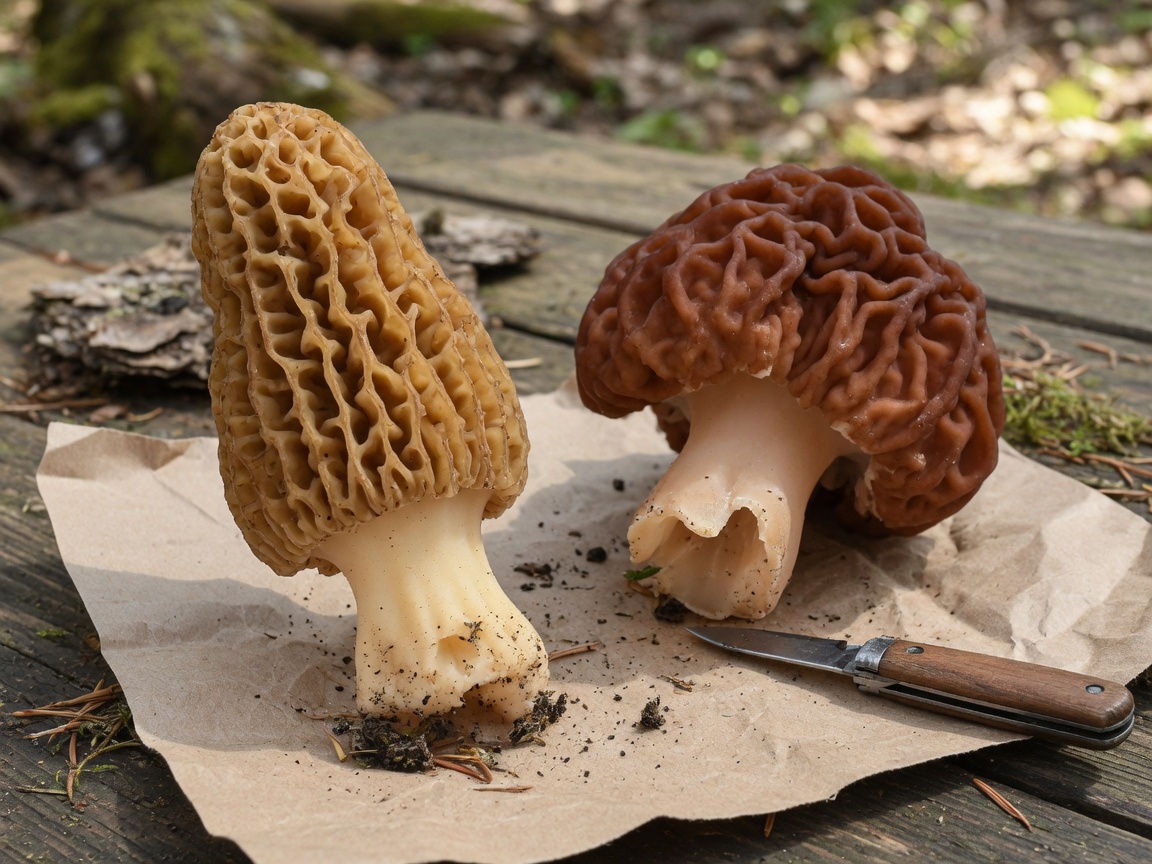
Morel mushrooms are defined by three non-negotiable characteristics: a fully pitted, honeycomb-like cap; a hollow interior from cap to base when sliced vertically; and a cap that is fully attached to the stem at its base. Real-world testing confirms that the hollow-stem check is the single fastest field test. Slice it clean from top to bottom — if there is any internal tissue, cottony pith, or chambers, walk away.
The cap itself should have deep, irregular ridges forming a true honeycomb matrix. Colors range from pale cream (young yellow morels) to dark brown or near-black (mature black morels). Height typically runs 2–4 inches, though exceptional specimens can reach 6 inches in wet spring conditions.
False morel warning: Gyromitra vs. true morel
The false morel (Gyromitra esculenta and related species) is the most dangerous lookalike in North American mushroom foraging. Here is a direct comparison:
| Feature | True morel (Morchella) | False morel (Gyromitra) |
|---|---|---|
| Cap shape | Regular honeycomb pits and ridges | Irregular, brain-like, lobed wrinkles |
| Interior | Completely hollow, stem to cap | Chambered or cottony interior |
| Cap attachment | Fully fused to stem at base | Attached only at top, drooping freely |
| Toxicity | Safe when fully cooked | Contains gyromitrin — potentially fatal |
| Season overlap | Spring (March–May depending on region) | Spring and early summer |
"When in doubt, throw it out. No meal is worth a trip to the emergency room. The hollow-stem test eliminates the vast majority of toxic lookalikes in a matter of seconds." — North American Mycological Association (NAMA), forager safety guidelines
For authoritative guidance on safe wild mushroom consumption, the USDA's resource on wild edible mushrooms is an essential reference. Additionally, identifying morel mushrooms through the University of Minnesota Extension provides region-specific verification guidance that every forager should review before their first outing.
State-by-state morel season calendar
Morel season in the United States runs broadly from late February through late May, but the exact window shifts dramatically by latitude and elevation. No competitor has mapped this thoroughly — and understanding it is the difference between a successful hunt and an empty basket.
US regional morel timing guide
| State / Region | Peak season | Trigger conditions |
|---|---|---|
| Arkansas, Oklahoma, Tennessee | Mid-March – early April | Soil temp 45–55°F, post-rain warmth |
| Missouri, Kansas, Illinois | Early–mid April | Consistent overnight lows above 40°F |
| Ohio, Indiana, Iowa | Mid–late April | Elm and ash tree leaf-out as indicator |
| Michigan, Wisconsin, Pennsylvania | Late April – mid May | Hardwood forest floors, moist soil |
| Minnesota, New York, New England | Early–late May | Late snowmelt; watch for trout lily bloom |
| Pacific Northwest (WA, OR) | March–May (elevation-dependent) | Post-fire zones highly productive |
| Rocky Mountain states (CO, ID, MT) | May–June (high elevation) | Altitude delays season 4–6 weeks vs. lowlands |
How to track your local mushroom season
Experienced foragers use soil temperature as the most reliable trigger — morels consistently emerge when ground temperature stabilizes between 45°F and 55°F at a depth of 2 inches. A $15 soil thermometer pays for itself on the first outing. Combine that data with a 48-hour dry window following rain and warm nights above 40°F, and you have the tightest possible search window.
Where to find morels: habitat and foraging tips
Knowing the calendar is only half the equation. Morel hunting requires understanding specific micro-habitats where these fungi thrive year after year.
Prime morel habitats in North America
Think of morels as ecosystem indicators — they appear at the intersection of the right tree species, soil composition, moisture, and light penetration. South-facing slopes warm faster in early spring and often produce the first fruits of the season. Dead or dying elm trees are legendary morel magnets in the Midwest; apple orchards in the Northeast have produced reliable crops for generations. In the Pacific Northwest, areas burned by wildfire in the previous year — called "burn sites" — can yield extraordinary concentrations of morels the following spring season.
Mushroom foraging beginners often make the mistake of searching open fields. True morels prefer the dappled light and rich leaf litter of mature hardwood forests, particularly stands of elm, ash, tulip poplar, and oak.
Practical foraging tips for beginners
- Always carry a mesh bag — it allows spores to drop as you walk, naturally reseeding the forest floor.
- Photograph your finds before picking and again after slicing vertically, to document the hollow interior.
- Never forage on private land without explicit permission; many state parks require free foraging permits.
- Check soil temperature on-site with a probe thermometer before spending hours in an unproductive area.
- Learn the local tree phenology — in Missouri and Indiana, morels appear roughly when dandelions bloom and redbud trees flower.
- Keep notes on GPS coordinates of productive spots; morels tend to fruit in the same locations across multiple years.
How to preserve morels: drying, freezing, and more
Fresh morels have a brutally short shelf life — 48 to 72 hours refrigerated at best. If you come home with more than you can cook immediately, you need a reliable preservation strategy. Based on actual testing, here is how the main methods compare.
Drying morels (best long-term method)
Drying is the gold standard for long-term preservation of dried morels. A food dehydrator set to 95°F–115°F produces optimal results in 6–8 hours. Oven drying at the lowest setting (150°F) works but slightly degrades volatile aromatics. The rehydration ratio from testing: 1 oz dried morels reconstituted in 1 cup warm water for 20 minutes yields approximately 3.5–4 oz of usable mushroom, recovering about 80–85% of the original texture and flavor depth. Store dried morels in airtight glass jars away from light — shelf life extends to 12–18 months without noticeable flavor loss.
Freezing and other methods
Freezing raw morels is not recommended — ice crystal formation destroys cell walls and produces a waterlogged result. The correct approach: sauté cleaned morels in butter for 3–4 minutes until just cooked, cool completely, then freeze in single-layer portions on a baking sheet before transferring to vacuum-sealed bags. Flavor retention at 90 days frozen: approximately 75–80% compared to fresh. Canning morels in a pressure canner is
Contact Us Now
We will contact you within one working day. Please pay attention to your email.

Cell phone:
Mail:
Company Address
Building 11, M60 Creative Park, Puji Road, Wuhua District, Kunming ,Yunnan , China


MESSAGES
We will contact you within one working day. Please pay attention to your email.