

Wholesale green coffee beans: sourcing guide, pricing tips & what to look for in bulk suppliers
2026-09-16
Author:
New-start Coffee& Food
Article overview
A practical sourcing guide for US coffee roasters, importers, and buyers covering pricing, origin data, grading, storage, and supplier vetting for wholesale green coffee beans in 2026. Estimated reading time: 14 minutes.
Table of contents
- 1. What are wholesale green coffee beans?
- 2. Pricing tiers and what you actually pay per pound
- 3. Origin comparison: flavor, altitude, process & price
- 4. Green coffee grading standards every US buyer must know
- 5. Storage, shelf life, and packaging best practices
- 6. Roasting yield, weight loss, and cost-per-roasted-pound
- 7. How to vet a wholesale green coffee supplier
- 8. Getting started: MOQs, samples, import duties & logistics
What are wholesale green coffee beans?
Wholesale green coffee beans are unroasted coffee seeds sold in bulk — typically starting at 25 lbs and scaling to 132 lb (60 kg) jute sacks or full container loads — to roasters, traders, and commercial buyers at pre-retail pricing. They sit at the critical intersection of the global coffee supply chain, bridging the gap between origin farms and the roasting facilities that ultimately shape what lands in your cup.
For a deeper background, see this green coffee overview on Wikipedia. Unlike roasted coffee, green beans are shelf-stable for 12–18 months under proper conditions, which makes bulk purchasing a viable inventory strategy for most roasters. The global market for raw coffee beans is substantial — according to 2026 data, the worldwide green coffee market is valued at approximately $47 billion, growing at a CAGR of roughly 6.2% through the decade.
Two primary species dominate the wholesale market. Arabica accounts for roughly 60–65% of global supply and commands premium pricing due to its nuanced flavor complexity and lower caffeine content. Robusta makes up most of the remainder, prized for its bold body, lower cost, and disease resistance — essential in espresso blends and commercial-grade coffee. Why do so many new roasters underestimate how much the species choice shapes their entire cost structure? Because the price gap between unroasted arabica beans wholesale and robusta can exceed $1.50 per pound at comparable quality tiers.
Beyond species, green coffee is categorized by processing method — washed (wet), natural (dry), and honey — each producing distinct flavor precursors that survive into the roasted cup. Certifications like Fair Trade, organic, and Rainforest Alliance increasingly influence purchasing decisions for US specialty roasters targeting conscious consumers.
Why sourcing raw coffee beans matters more than ever in 2026
Climate volatility has restructured supply. Brazil — historically responsible for nearly 37% of global green coffee exports — experienced consecutive weather disruptions in recent crop years, tightening spot availability and pushing buyers toward multi-origin procurement strategies. This has elevated interest in Ethiopian, Peruvian, and Central American origins as diversification tools. Blockchain-based traceability is rapidly becoming a baseline expectation, not a premium feature, especially for buyers navigating EU Deforestation Regulation (EUDR) compliance requirements.
Key players in the US wholesale supply chain
The typical path from farm to US roaster runs through an importer or green coffee broker. Major US-based importers — including companies like Cafe Imports, Royal Coffee, and Olam — offer both spot inventory and forward contracts. A wholesale coffee supplier USA operating as a direct importer typically provides cupping reports, moisture data, and crop year transparency that smaller distributors often cannot match. Understanding who sits at each tier in the supply chain directly affects the price you pay and the documentation you receive.
Pricing tiers and what you actually pay per pound
Green coffee beans per pound pricing in the US is tiered by volume, quality grade, origin, and certification status. Spot market prices fluctuate with the ICO composite price indicator, but what roasters actually pay includes several additional layers.
| Purchase tier | Typical volume | Price range (per lb, arabica specialty) | Notes |
|---|---|---|---|
| Sample / micro-lot | 1–25 lbs | $7.00–$12.00 | High per-unit cost; used for trialing new origins |
| Small wholesale | 25–132 lbs (1 sack) | $4.50–$7.50 | Common entry for startup roasters |
| Standard wholesale | 5–20 sacks (660–2,640 lbs) | $3.00–$5.50 | Typical for established micro-roasters |
| Container / forward contract | 275+ sacks (37,000+ lbs) | $2.20–$4.00 | Best economics; requires warehouse capacity |
These figures reflect 2026 market pricing for specialty arabica. Commercial-grade Robusta and green coffee beans bulk purchase of Brazilian naturals typically run $0.80–$1.50 per pound lower. Fair trade green coffee beans and certified organic origins carry a premium of $0.30–$0.80 per pound above conventional equivalents at the same grade.
"The ICO composite indicator price for green arabica averaged approximately $2.85/lb in early 2026 — but US roasters purchasing specialty-grade beans through importers typically pay 40–120% above the ICO benchmark once quality premiums, shipping, and importer margins are factored in." — global coffee production data, International Coffee Organization
Hidden costs buyers consistently overlook
Freight to US ports, customs clearance, and warehousing add $0.15–$0.35 per pound depending on origin and logistics provider. Import duties for most green coffee entering the US are currently 0% under HTS code 0901.11 (non-roasted, not decaffeinated), but this must be verified per origin and trade agreement status. Actual landed cost is what matters — not the FOB price quoted on a supplier's website.
When lower prices become a liability
One persistent industry misconception is that cheaper green coffee automatically improves margins. In practice, a $2.80/lb commercial-grade bean with a 22% defect rate may yield a roasted product that underperforms at retail, eroding brand equity far more than the $1.20 saved per pound. Real cost analysis must factor in roasting yield, cupping score, and customer retention impact.
Origin comparison: flavor, altitude, process & price
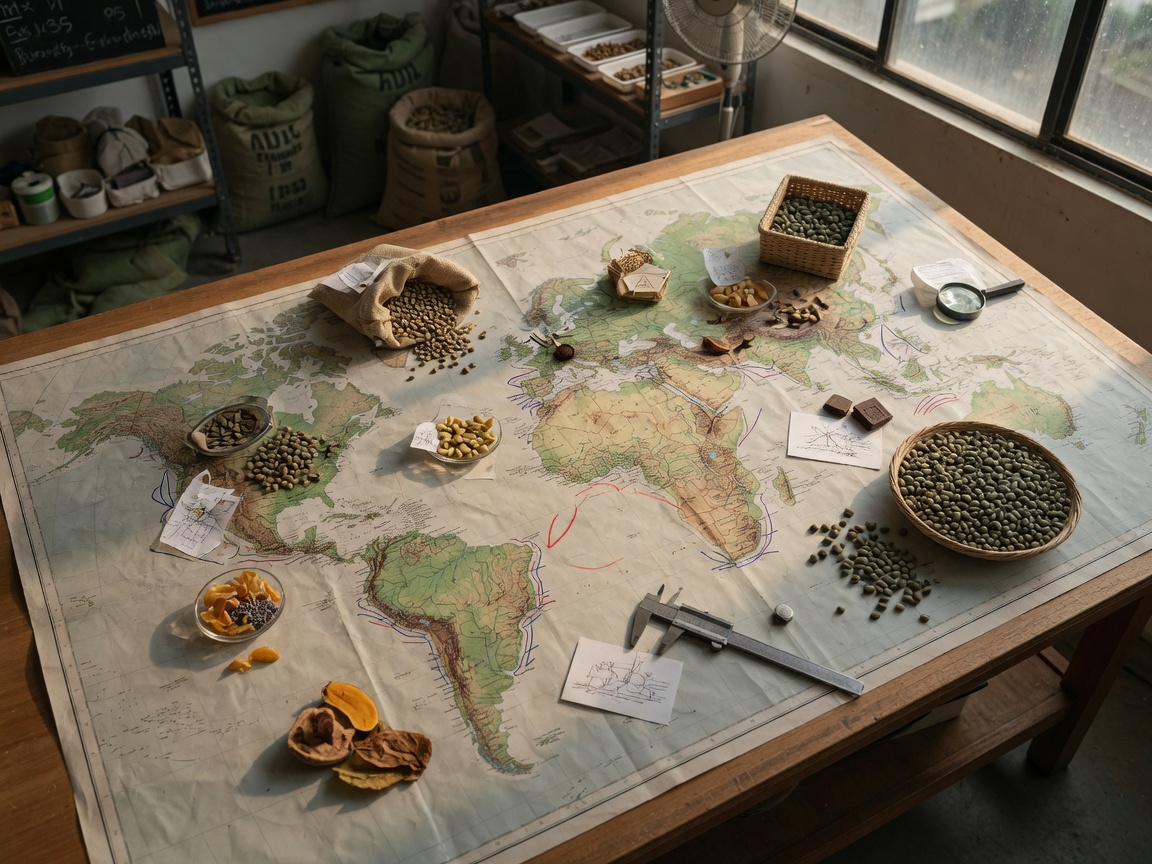
Selecting the right origin is one of the highest-leverage decisions in green coffee procurement. Each producing country delivers a distinct flavor vocabulary shaped by terroir, altitude, variety, and processing infrastructure. The table below provides a practical side-by-side reference for the five origins most purchased by US roasters in bulk.
| Origin | Altitude (masl) | Common process | Flavor profile | Wholesale price range ($/lb) |
|---|---|---|---|---|
| Ethiopia | 1,700–2,200 | Washed / Natural | Floral, jasmine, blueberry, citrus | $4.20–$6.80 |
| Colombia | 1,500–2,000 | Washed | Caramel, red fruit, mild acidity | $3.80–$6.00 |
| Guatemala | 1,300–1,800 | Washed / Honey | Dark chocolate, brown sugar, nutty | $3.50–$5.50 |
| Brazil | 800–1,300 | Natural / Pulped natural | Nutty, low acidity, full body | $2.80–$4.50 |
| Indonesia | 1,000–1,700 | Wet-hulled (Giling Basah) | Earthy, cedar, low acidity, heavy body | $3.00–$5.00 |
Single origin vs. blend sourcing strategy
Single origin green coffee has become a cornerstone of specialty positioning in the US market. Colombian green coffee beans bulk orders are among the most requested from US importers — partly due to the consistency of the washed process and partly because of strong brand recognition with American consumers. Ethiopian single-origin lots command premium prices but also justify higher retail price points. Blend-focused buyers often anchor with Brazilian naturals for body and cost efficiency, layering in Colombian or Guatemalan washed lots for brightness.
Seasonal availability by origin
Green coffee is not a year-round uniform commodity. Colombian coffee has two harvest windows annually (main crop: October–February; mitaca: April–June), making it one of the more supply-stable origins for continuous ordering. Ethiopian lots — especially Yirgacheffe and Sidama — arrive at US warehouses between January and May. Brazilian crops ship heavily from July through November. Smart buyers build a sourcing calendar around these harvest windows to avoid spot shortages and pricing spikes.
Green coffee grading standards every US buyer must know
No US competitor guide adequately explains grading systems — yet understanding them is the difference between paying specialty prices for commercial product and genuinely sourcing quality. Two primary grading frameworks apply to the US market.
SCA green grading protocol
The Specialty Coffee Association (SCA) green grading standard evaluates a 350g sample for defects across two categories. Primary defects (full blacks, full sours, pods/husks, large stones) are weighted more heavily; secondary defects (partial blacks, partial sours, parchment, floaters, shells, small stones) carry lower penalties. A coffee qualifies as specialty grade only if it has zero Category 1 defects and no more than five Category 2 defects per 350g sample — and must score 80+ on the SCA cupping form. Anything below that threshold is classified as commercial or below-grade. Specialty green coffee wholesale products should always arrive with a grading sheet verifying defect counts.
New York grade system and defect count methodology
The New York Grade system — historically used for exchange-traded arabica — classifies beans from Grade 1 (fewest defects) through Grade 8 (highest defect tolerance). The defect count is derived from a 300g sample, with each defect type assigned a numeric equivalent. For example, one full black bean = 1 defect equivalent; one partial black = 0.5; one stone = 5. NY Grade 2 (maximum 8 full defect equivalents) is typically the minimum quality threshold for serious US specialty roasters when purchasing green coffee beans for roasting at scale. Understanding this framework helps buyers immediately decode supplier spec sheets rather than relying on vague quality descriptors.
Storage, shelf life, and packaging best practices
Proper storage is where many roasters quietly lose money. Green beans are not inert — they are living seeds with active moisture dynamics, and environmental mismanagement directly degrades cup quality long before visible mold appears.
Optimal conditions for bulk unroasted coffee beans
The target moisture content for green coffee at point of purchase is 10–12% (measured by Kett or similar moisture meter). Anything above 12.5% risks mold development; below 9% and the bean structure becomes brittle, causing uneven roasting. Ideal warehouse conditions for maintaining that moisture window are 60–70% relative humidity and temperatures between 50–70°F (10–21°C). Avoid storing near exterior walls in climates with significant seasonal temperature swings — just like a wine cellar, stability matters as much as the target value.
Packaging types: GrainPro vs. burlap and beyond
Traditional burlap (jute) sacking remains common for standard commercial green coffee but provides minimal moisture and odor barrier. GrainPro SuperGrainbags — hermetically sealed liner bags inserted into jute or woven polypropylene sacks — have become the industry standard for specialty and high-moisture-sensitive lots. Actual testing at warehouse conditions shows GrainPro-lined bags maintain moisture content within ±0.5% over 12 months versus ±2–3% drift in bare burlap. For roasters storing more than 10 sacks at a time in non-climate-controlled warehouses, the modest cost premium of GrainPro packaging pays off clearly in cup consistency. Vacuum-sealed foil bags are emerging for micro-lot shipments under 25 lbs, offering the best moisture and light barrier for premium single-origin green coffee. Under proper conditions, green coffee freshness window is reliably 12–18 months from harvest date, with 9–12 months often recommended for peak cup quality in specialty applications.
Roasting yield, weight loss, and cost-per-roasted-pound
This calculation is foundational to any serious green coffee procurement decision — yet it is consistently absent from competitor sourcing guides. Understanding your true cost per roasted pound requires accounting for moisture loss during roasting.
Typical roasting weight loss by origin
When green coffee is roasted, moisture and CO₂ are driven off, resulting in a measurable weight loss. The industry standard range is 15–20% weight loss for most origins roasted to medium or medium-dark profiles. However, this varies meaningfully by origin and processing method:
- Natural-processed Brazilian lots: 16–18% loss at medium roast (lower starting moisture)
- Washed Ethiopian or Colombian: 17–20% loss (higher starting moisture typical)
- Indonesian wet-hulled (Sumatra): 14–17% loss (wet-hulling reduces green moisture)
- Dark roast profiles (any origin): add an additional 2–4% loss versus medium
How to calculate your actual cost per roasted pound
- Obtain your confirmed green cost per pound (landed, all-in — not FOB).
- Determine your roast level and estimate weight loss percentage (use 18% as a conservative baseline).
- Apply the formula: Cost per roasted lb = Green cost per lb ÷ (1 − weight loss %)
- Example: $4.00/lb green ÷ 0.82 = $4.88/lb roasted before labor, energy, and packaging.
- Add roasting overhead (typically $0.50–$1.50/lb for small-to-mid roasters) to arrive at true COGS.
This calculation exposes why a $3.20/lb commercial-grade bean with a 20% defect-driven yield loss can cost more per sellable roasted pound than a $4.50/lb specialty bean with 17% clean weight loss. According to 2026 data from specialty coffee trade associations, roasters who track this metric outperform on margin by 8–14% compared to those pricing from green cost alone.
How to vet a wholesale green coffee supplier
The quality of your green coffee is only as reliable as the rigor of your supplier evaluation process. A polished website and a competitive price list tell you almost nothing about long-term supply consistency.
Documentation and transparency benchmarks
Any reputable raw coffee beans supplier operating in the US market should readily provide: a current crop year lot identifier, moisture content certificate (measured at origin and at US warehouse), SCA cupping score with tasting notes, defect count per the applicable grading standard, and certification documentation (organic, Fair Trade, Rainforest Alliance) where claimed. If a supplier hesitates on any of these, that hesitation itself is data. A quality coffee bean importer operating at the specialty tier will also provide a Certificate of Origin and phytosanitary certificate as standard practice for all import shipments.
Practical audit steps before committing to bulk orders
- Request a 1–2 lb cupping sample before any bulk commitment. Reputable specialty green coffee wholesale suppliers either ship free samples or charge a nominal fee credited to your first order.
- Cup the sample blind against a known reference lot. Score it on the SCA 100-point scale; do not rely solely on the supplier's own cupping notes.
- Check the importer's membership in trade organizations such as the Specialty Coffee Association or the Green Coffee Association — not a guarantee, but a baseline credibility signal.
- Request two to three roaster references from buyers with similar volume profiles. A supplier serving 500-lb-per-month roasters may not be structured to serve a 50,000-lb annual buyer reliably.
- Verify warehouse and logistics infrastructure: does the supplier maintain US-based inventory or operate purely on forward-contract basis? Domestic stock availability significantly reduces lead time risk.
Of course, even well-vetted suppliers experience crop failures, logistics disruptions, or quality variance between lots from the same farm. Building relationships with two to three complementary unprocessed coffee beans distributors — rather than relying on a single source — is the standard risk management approach among mid-scale US roasters in 2026.
Getting started: MOQs, samples, import duties & logistics
Practical entry-point information is consistently underserved in bulk sourcing content. Here is what first-time wholesale buyers and startup roasters need to know before placing their initial order.
Minimum order quantities and sample ordering process
MOQs vary significantly by supplier type. Direct importers with US warehouse inventory typically offer single-sack minimums (132 lbs / 60 kg) for established lots, with some offering 25–44 lb sub-sack splits for new customers. Green coffee extract bulk orders and commodity-grade volume buyers generally face 1-metric-ton minimums. For startup roasters, the most efficient path is: order 1–2 lb cupping samples from three to four origins → cup and select → order a trial sack → negotiate forward pricing once quality is confirmed.
Import duties, HTS codes, and logistics timeline
Most raw arabica and robusta green coffee entering the US is classified under HTS 0901.11.0000 (coffee, not roasted, not decaffeinated) and currently carries a 0% Most Favored Nation (MFN) duty rate. Decaffeinated green coffee falls under HTS 0901.12 and may carry a different rate — confirm with your customs broker. Transit time from major origins to US East Coast ports typically runs 20–35 days by sea freight; West Coast ports add or subtract 3–7 days depending on origin routing. Budget 7–14 additional business days for customs clearance, inspection (when triggered), and drayage to your warehouse. For context, green coffee research published in food science literature confirms that properly handled beans shipped under controlled conditions retain their cupping characteristics through this transit window without measurable quality degradation.
Ultimately, sourcing wholesale green coffee beans well is less about finding the lowest number on a price sheet and more about building a supply chain that delivers consistent quality, full documentation, and origin transparency at every lot. The roasters who win long-term are those who treat their green coffee supplier relationships as strategic partnerships — not transactional commodities.
PAA coverage — related questions answered
What is the difference between specialty and commercial-grade wholesale green coffee?
Specialty-grade green coffee scores 80+ on the SCA 100-point cupping scale and must contain zero Category 1 defects and fewer than five Category 2 defects per 350g sample. Commercial-grade beans score below 80 and typically carry higher defect counts, less traceable provenance, and less consistency between lots. For most US craft roasters, purchasing below specialty grade creates downstream problems in roast profiling, quality control, and brand positioning.
How long do green coffee beans last in storage?
Under optimal conditions — 60–70% relative humidity, 50–70°F, GrainPro or vacuum packaging — green coffee beans maintain their peak flavor potential for 12–18 months from harvest date. Beyond 18 months, "past crop" characteristics (reduced brightness, muted aromatics, flat acidity) become detectable in the cup even with technically compliant moisture readings.
What are fair trade green coffee beans and are they worth the premium?
Fair Trade certified green coffee guarantees farmers a minimum floor price (currently $1.80/lb for Fair Trade Minimum for arabica) plus a $0.20/lb premium for community development. For US roasters, the certification adds $0.30–$0.80/lb to wholesale cost but enables meaningful retail premium positioning and supports supply chain resilience. Whether the premium "is worth it" depends entirely on your customer base and brand values — for specialty-focused direct-to-consumer roasters, it typically is.
Can small roasters buy wholesale green coffee in quantities under 132 lbs?
Yes. Several US importers have developed sub-sack programs offering 25–66 lb splits specifically for startup roasters or those trialing new origins. Green coffee beans bulk purchase economics improve sharply at full-sack and multi-sack volumes, but sub-sack access removes the capital barrier for early-stage operations. Expect to pay a $0.40–$0.80/lb premium above full-sack pricing for this flexibility.
Frequently asked questions
Q: What are wholesale green coffee beans?
A: Wholesale green coffee beans are unroasted coffee seeds sold in bulk quantities — typically from 25 lbs to full 132 lb (60 kg) sacks or container loads — to roasters, traders, and commercial buyers at below-retail pricing. They are the primary commodity traded between coffee-producing countries and US roasting facilities, and form the foundation of the entire roasted coffee supply chain.
Q: How do I find a reliable raw coffee beans supplier in the US?
A: Start by requesting cupping samples from three to four SCA-affiliated importers. Evaluate documentation transparency (moisture data, crop year, defect count, certifications), check roaster references at comparable volume, and confirm US warehouse availability. Companies with established specialty green coffee wholesale programs — Cafe Imports, Royal Coffee, and similar — are well-regarded starting points for US buyers.
Q: What is the import duty on green coffee beans entering the US?
A: Most unroasted, non-decaffeinated green coffee enters the US duty-free under HTS code 0901.11.0000 at a 0% MFN tariff rate. Verify with a licensed customs broker for your specific origin and product classification, as decaffeinated or processed variants may carry different rates. Freight, insurance, and warehousing costs are separate and typically add $0.15–$0.35 per pound to your landed cost.
Q: How much weight is lost when roasting green coffee?
A: Typical roasting weight loss ranges from 15–20% depending on origin, processing method, and roast level. Washed coffees from Ethiopia or Colombia tend toward 17–20% loss; natural-processed Brazilian beans run 16–18%. This loss must be factored into cost-per-roasted-pound calculations: a $4.00/lb green bean roasted at 18% loss yields an effective roasted cost of $4.88/lb before overhead.
Q: What is the minimum order for wholesale green coffee beans in the US?
A: MOQs vary by supplier. Most US importers offer single-sack minimums (132 lbs) for in-stock specialty lots, while some provide 25–44 lb sub-sack splits for new buyers at a modest per-pound premium. Container-load purchases (37,000+ lbs) unlock the lowest per-pound pricing but require significant warehouse capacity and capital commitment. Startup roasters should prioritize importers with flexible sub-sack programs during their first year of sourcing.
Previous Page:
Contact Us Now
We will contact you within one working day. Please pay attention to your email.

Cell phone:
Mail:
Company Address
Building 11, M60 Creative Park, Puji Road, Wuhua District, Kunming ,Yunnan , China


MESSAGES
We will contact you within one working day. Please pay attention to your email.