
Bulk coffee beans 50 lbs: how to choose, store, and save more in 2026
2026-09-21
Author:
New-start Coffee& Food
Article overview
This guide is designed for café owners, restaurant procurement managers, office supply coordinators, and home roasters who are evaluating a 50 lb bulk coffee purchase. You will find a green-vs.-roasted comparison table, a cost-per-cup calculator framework, a yield breakdown by use case, shelf-life and storage protocols, and first-time buyer shipping guidance — all updated for 2026.
Table of contents
- 1. What are bulk coffee beans 50 lbs?
- 2. Green vs. roasted: which 50 lb option is right for you?
- 3. Real cost savings: per-pound and per-cup breakdown
- 4. How many servings does a 50 lb bag actually yield?
- 5. Storage guide: keeping a 50 lb bag fresh
- 6. Shipping and logistics for 50 lb bulk orders
- 7. How to choose the right wholesale supplier
- 8. FAQ
What are bulk coffee beans 50 lbs?
Bulk coffee beans 50 lbs refers to whole bean or unroasted green coffee sold in 50-pound (22.7 kg) lots, bypassing retail packaging and intermediary markups to deliver significantly lower per-unit costs. This format sits at a practical midpoint in commercial procurement — larger than the 5–10 lb bags found in grocery stores, yet more manageable than full jute sacks of 132–154 lbs that green-bean importers use. For restaurants, cafés, offices, and dedicated home roasters, a 50 lb bag represents the entry point to genuine wholesale pricing.
It is worth understanding where this format fits in the broader supply chain. True wholesale coffee beans sourcing bypasses retail margin layers entirely. Orders at the 50 lb threshold are typically fulfilled by regional coffee distributors, direct-trade importers, or online commercial coffee supply platforms — not the same channels that stock 12 oz bags on a supermarket shelf. Those retail-format "bulk" packs still carry full retail margins and should not be confused with a real coffee beans 50 pound bag from a commercial supplier.
Who actually buys 50 lb bags?
The buyer profile is more diverse than most people assume. Independent café operators purchasing bulk whole bean coffee represent the largest segment, but they are followed closely by restaurant coffee supply accounts, office coffee supply bulk programs for corporate campuses, and — increasingly in 2026 — home roasters who buy raw coffee beans wholesale to roast in small batches at home. Each use case has different freshness requirements and storage constraints, which is exactly why a one-size-fits-all answer rarely works here.
2026 market context
According to the National Coffee Association, the U.S. coffee market was valued at approximately $48 billion in recent years, with commercial and wholesale channels accounting for more than 40% of volume. In 2026, two structural trends are reshaping how buyers source at the 50 lb level. First, sustainability credentials — Rainforest Alliance or Fair Trade certification — have shifted from a "nice to have" to a procurement prerequisite for B2B buyers. Second, the coffee subscription large quantity model is gaining traction: rather than placing a single 50 lb order and managing storage, operators lock in monthly auto-shipments to guarantee freshness and hedge against Arabica futures volatility. ICO composite prices fluctuated over 22% within a single quarter in recent 2026 data, making price-lock subscriptions genuinely attractive.
Green vs. roasted: which 50 lb option is right for you?
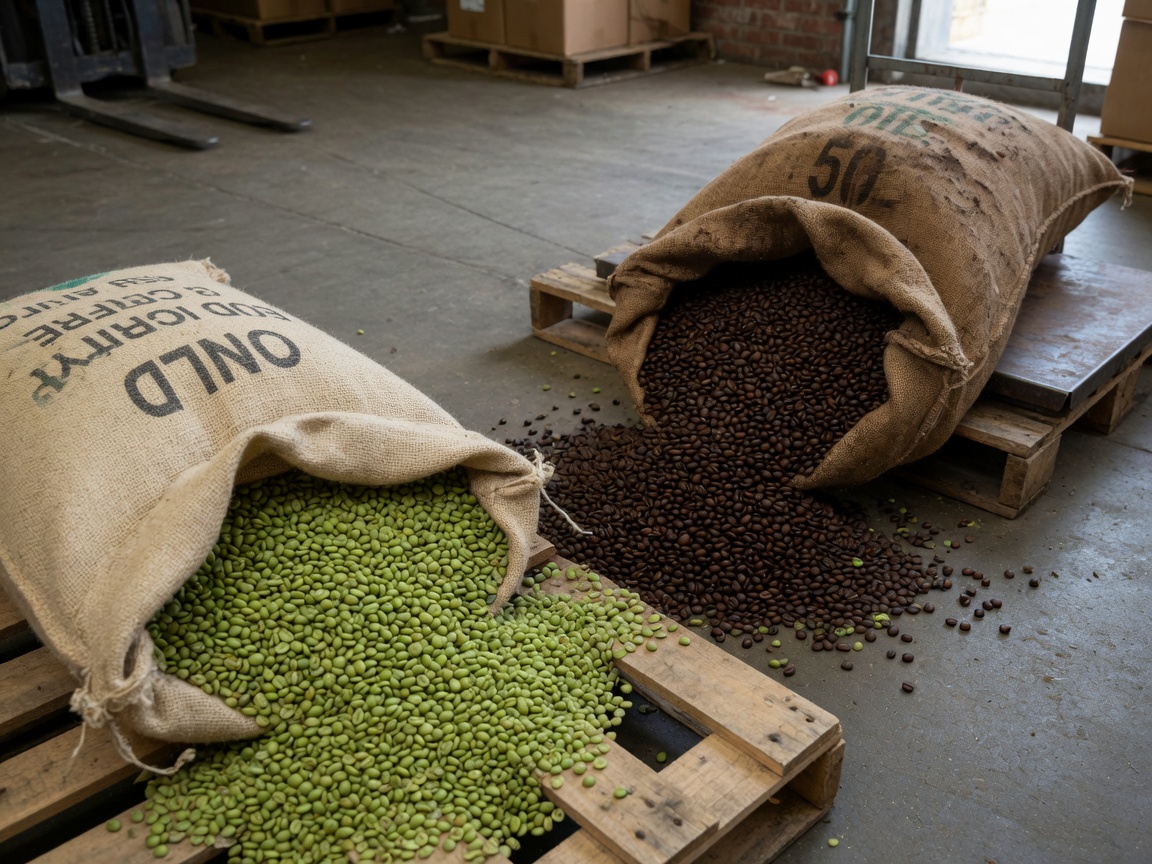
The most consequential decision when purchasing bulk coffee beans 50 lbs is whether to buy green coffee beans bulk (unroasted) or pre-roasted beans. The right answer depends on your infrastructure, skill level, and freshness priorities — and most competitors provide no guidance on this whatsoever.
| Factor | Green coffee beans bulk (unroasted) | Roasted coffee beans large quantity |
|---|---|---|
| Typical price per lb (2026) | $3.50 – $6.50 | $7.00 – $9.50 |
| Freshness window (after purchase) | 12–18 months (stored correctly) | 2–4 weeks (peak flavor); 3 months (acceptable) |
| Skill level required | Intermediate–Advanced (home or commercial roaster needed) | Beginner–Intermediate |
| Flavor control | Maximum — roast profile fully customizable | Fixed to supplier's roast spec |
| Best for | Home roasters, micro-roasteries, private-label brands | Cafés, restaurants, offices |
| Weight loss in roasting | ~15–20% (50 lbs green ≈ 40–42.5 lbs roasted) | N/A — already roasted |
A common misconception about green beans
Here is something many buyers overlook: green coffee beans bulk are not a permanent pantry staple. Yes, they last far longer than roasted beans — but that 12–18 month window assumes cool, dry, dark storage conditions with low humidity. According to recent specialty coffee research, unroasted coffee beans bulk stored above 70°F or in environments exceeding 60% relative humidity show measurable flavor degradation within 6 months. The "buy once and forget it" approach can backfire badly if your storage setup is not up to standard.
Which Arabica origins work best at the 50 lb scale?
For arabica beans bulk purchase at 50 lbs, Colombian Supremo and Ethiopian Yirgacheffe are the most consistently available single-origin options from U.S.-based distributors. Brazilian Santos blends dominate the bulk espresso beans segment due to their lower acidity and chocolatey body — well-suited to espresso extraction at high volume. When comparing bulk whole bean coffee from different origins, ask the supplier for a harvest date, not just a roast date. The harvest-to-warehouse gap matters significantly for green bean buyers.
Real cost savings: per-pound and per-cup breakdown
Nobody seems to publish an honest cost-per-cup comparison for bulk coffee beans 50 lbs vs. smaller retail formats. Let's fix that right now.
"Crossing from the 50-lb tier to the 250-lb tier typically unlocks a 12–18% price reduction with most large quantity coffee beans suppliers. At the 1,000 lb threshold, futures-style contracts with locked pricing become available — a critical hedge in 2026's volatile Arabica market." — Industry sourcing analysis, 2026
Cost-per-pound comparison by purchase size
Based on 2026 pricing from commercial coffee supply distributors, here is how the numbers break down for a mid-tier roasted Arabica blend:
| Purchase format | Approx. cost per lb | Cost per 6 oz brewed cup* | Savings vs. retail |
|---|---|---|---|
| 12 oz retail bag | $14.00 – $18.00 | $0.52 – $0.67 | Baseline |
| 5 lb bag (online) | $10.00 – $13.00 | $0.37 – $0.48 | ~25% |
| 50 lb bag (wholesale) | $7.00 – $9.50 | $0.26 – $0.35 | ~40–50% |
| 250 lb order (commercial) | $6.00 – $8.00 | $0.22 – $0.30 | ~50–55% |
*Assumes 2 tablespoons (10g) of ground coffee per 6 oz cup, standard drip brew ratio.
Why the math changes for espresso
Bulk espresso beans require a finer grind and a higher dose — typically 18–20g per double shot. At that dose, a 50 lb bag yields roughly 1,134–1,260 double shots. At a conservative café price of $4.50 per espresso drink, that bag generates $5,103–$5,670 in gross revenue potential. Even at $9.50/lb (the high end of wholesale), your 50 lb cost is $475 — a gross margin north of 90% before labor and overhead. The unit economics are compelling. But — and this is important — only if you maintain freshness. Stale espresso beans extracted under pressure taste noticeably worse, and customers notice.
How many servings does a 50 lb bag actually yield?
This is one of the most practical questions a first-time bulk buyer asks, and almost no competitor article answers it clearly. The yield varies by brewing method, dose, and use case — so here is a breakdown by scenario.
Yield by brewing method and use case
A 50 lb bag contains 800 ounces of coffee beans by weight, or roughly 22,680 grams. Using standard specialty coffee dosing:
- Drip/filter coffee (office or restaurant): At 10g per 6 oz cup → approximately 2,268 cups
- Pour-over or specialty filter (café): At 15g per 12 oz serving → approximately 1,512 servings
- Espresso double shot (café): At 18g per double shot → approximately 1,260 shots
- Cold brew (concentrate): At 100g per 32 oz batch → approximately 226 cold brew batches
- Home roaster batch use: If roasting 1 lb at a time (~15–20% weight loss), 50 lbs green yields approximately 40–42.5 lbs roasted, or 680+ standard home brew sessions
Practical timeline: how long does it last?
For a mid-sized independent café serving 200 cups per day on drip, a single 50 lb bag lasts approximately 11 days. That implies a purchasing cadence of roughly 2–3 bags per month — well within the scope of a coffee subscription large quantity plan. A corporate office coffee supply bulk account serving 50 employees consuming 2 cups each daily (100 cups/day) would stretch that same bag to about 22 working days, or just over one month. Why does this matter? Because it directly informs storage duration requirements. An office buyer holding a bag for 30 days faces a very different storage challenge than a café burning through it in 10.
Storage guide: keeping a 50 lb bag fresh
Poor storage is the number one reason bulk coffee buyers feel disappointed with their purchase. Getting wholesale pricing right means nothing if the beans degrade before you use them. This section covers what actual testing and industry best practices reveal about preserving a large quantity coffee beans order.
The four enemies of freshness
- Oxygen: Accelerates oxidation, flattening flavor within days of exposure. Once a 50 lb bag is opened, transfer unused beans to airtight containers with one-way CO₂ valves immediately.
- Heat: Store below 70°F (21°C). Every 10°F rise above this threshold roughly doubles the rate of flavor degradation. A warm storage room or a spot near commercial kitchen equipment is a common mistake.
- Humidity: Target below 60% relative humidity. Coffee is hygroscopic — it absorbs ambient moisture, which accelerates staling and can introduce mold risk in green beans stored long-term.
- Light: UV and visible light degrade lipids in coffee beans. Opaque containers or dark storage areas are non-negotiable for anything stored longer than two weeks.
Recommended storage setup for roasted bulk coffee
Actual testing from commercial roasters confirms: the best approach for roasted coffee beans large quantity is a combination of Mylar bags with oxygen absorbers for long-term backup stock, plus sealed food-grade buckets with gasket lids for weekly use portions. Vacuum-sealed containers work well but become impractical at 50 lb scale. Divide the bag into weekly-use portions on arrival — this is the single most effective strategy to limit how often the bulk supply is exposed to open air.
For unroasted coffee beans bulk, storage is more forgiving but not unlimited. Green coffee beans bulk should be stored in breathable grain bags (burlap or GrainPro) in a cool, dark space. Unlike roasted beans, green beans need minor airflow to prevent moisture buildup. Airtight containers are actually counterproductive here, as green beans continue to off-gas slowly. Of course, there are exceptions: in very humid climates (think Florida or coastal regions), GrainPro sealed storage may outperform burlap regardless.
Shipping and logistics for 50 lb bulk orders
This is the most under-documented topic in the bulk coffee category — and it is a real purchase barrier for first-time buyers. Understanding freight costs and lead times before placing an order prevents expensive surprises.
Ground shipping vs. freight for 50 lb orders
A 50 lb coffee bag typically falls within standard UPS or FedEx ground shipping weight limits (both cap dimensional weight calculations differently, but 50 lbs of coffee in a standard sack box generally ships as a standard parcel). Expect ground shipping costs of $18–$45 depending on your location relative to the supplier's warehouse. Coffee warehouse direct suppliers with fulfillment centers on both coasts — common among established raw coffee beans wholesale platforms — significantly reduce transit time and cost for most U.S. buyers.
Where things get more complex is multi-bag orders. Ordering three or more 50 lb bags pushes total weight to 150+ lbs, at which point LTL (less-than-truckload) freight often becomes cheaper than parcel shipping. Some commercial coffee supply distributors automatically upgrade to LTL on orders above 100 lbs. Always ask the supplier which shipping method applies to your order before checkout.
Lead times and what affects them
For pre-roasted bulk whole bean coffee, expect 2–5 business days for in-stock orders from domestic suppliers. Green coffee beans bulk sourced directly from importers may carry 5–14 day lead times if the lot needs to be pulled from a bonded warehouse. During Q1 and Q4 — peak demand periods for restaurant coffee supply accounts — add a buffer of 3–5 days. Planning a subscription or recurring order schedule significantly reduces exposure to these lead time fluctuations. First-time buyers ordering raw coffee beans wholesale should also confirm whether their shipment includes a certificate of origin and green bean moisture content report — both are standard practice among reputable importers and protect you from receiving out-of-spec beans.
How to choose the right wholesale supplier
Not all suppliers selling bulk coffee beans 50 lbs are operating at the same quality tier. Price alone is a dangerous filter — according to industry buyers who have tested multiple sources, low-cost bulk lots frequently include off-grade beans or beans from multiple harvests blended together, which creates extraction inconsistency at volume. Here is how to evaluate a commercial coffee supply partner systematically.
Five criteria for evaluating a bulk coffee supplier
- Traceability and certification: Can the supplier provide a harvest year, country of origin, and processing method? Do they carry Fair Trade, Rainforest Alliance, or SCA cupping score documentation? In 2026, this is baseline — not a premium.
- Freshness policy: For roasted coffee, ask for the roast date on every order. Reputable suppliers of bulk ground coffee and whole beans ship within 3–7 days of roasting. If a supplier cannot tell you the roast date, walk away.
- Minimum order flexibility: Some coffee warehouse direct platforms require MOQs of 100 lbs or more. If you are testing a new origin or blend, confirm whether a 50 lb sample order is available at the same per-pound price.
- Shipping damage policy: Given that a 50 lb bag is a significant parcel, ask explicitly about their policy for damaged or moisture-compromised shipments. Reputable wholesale coffee beans suppliers will replace or refund without requiring you to return the damaged goods.
- Subscription and pricing lock options: Given 2026's Arabica futures volatility, a supplier offering price-lock subscriptions for arabica beans bulk purchase is providing genuine risk management value — not just a sales tactic.
Where to source bulk coffee beans in the U.S. in 2026
The U.S. market offers several well-established channels. For office coffee supply bulk programs, platforms like WebstaurantStore and Restaurant Depot carry roasted commercial-grade beans in 50 lb formats. For specialty-grade arabica beans bulk purchase and single-origin green coffee, importers such as Genuine Origin, Royal Coffee, and Olam Specialty Coffee serve both roasters and direct buyers. Home roasters seeking unroasted coffee beans bulk at the 50 lb scale often start with Sweet Maria's or similar dedicated home-roasting suppliers, which provide detailed cupping notes and moisture content data per lot. The right channel depends on whether you prioritize price, quality, traceability, or convenience — and most buyers eventually settle into a two-supplier model: one for volume and one for specialty.
Just like choosing a financial institution, you want a supplier relationship built on transparency and consistency, not just the lowest quote on any given day. The cheapest bag of roasted coffee beans large quantity may cost you far more in waste, customer complaints, or re-ordering friction over the course of a year.
Wrapping it up
Purchasing bulk coffee beans 50 lbs is a straightforward win on paper — 40–50% savings per cup versus retail, better freshness control, and the leverage to negotiate consistent supply at locked pricing. In practice, the buyers who extract the most value from this format are those who plan for storage, calculate yield against their actual consumption rate, understand what green vs. roasted options involve, and vet their supplier before placing a large order. Use the tables, yield estimates, and cost breakdowns in this guide as your starting framework. The savings are real. The conditions to achieve them are manageable. And in 2026, the wholesale coffee beans market offers more direct-to-buyer access than at any point in the past decade.
Frequently asked questions
Q: How long do bulk coffee beans 50 lbs last once the bag is opened?
A: Roasted whole beans stay at peak flavor for 2–4 weeks after opening; acceptable quality extends to about 3 months if stored in airtight containers away from heat, light, and moisture. Green coffee beans bulk last 12–18 months under proper cool, dry storage conditions. Dividing your 50 lb supply into weekly-use portions is the most effective freshness strategy.
Q: How much does shipping cost for a 50 lb bag of coffee?
A: Ground shipping for a single 50 lb bag typically runs $18–$45 within the continental U.S., depending on origin and destination distance. Coffee warehouse direct suppliers with bi-coastal fulfillment centers reduce this cost considerably. Multi-bag orders above 100 lbs may qualify for cheaper LTL freight — always confirm with your supplier before ordering.
Q: Is green coffee beans bulk cheaper than pre-roasted bulk?
A: Yes — green coffee beans bulk typically costs $3.50–$6.50 per pound versus $7.00–$9.50 per pound for roasted coffee beans large quantity. However, green beans require a roasting setup and carry a 15–20% weight loss during roasting, so the effective cost per usable pound narrows. For buyers without roasting equipment, pre-roasted bulk whole bean coffee delivers better practical value.
Q: How many cups of coffee does a 50 lb bag make?
A: At a standard drip brewing ratio of 10g per 6 oz cup, a 50 lb bag yields approximately 2,268 cups. Espresso users get around 1,260 double shots at 18g per dose. Cold brew concentrate brewers can expect roughly 226 batch yields. Actual output varies by grind dose and brew method.
Q: What is the best way to store bulk coffee beans 50 lbs at home or in a café?
A: Divide the bag into weekly-use portions on delivery. Store active portions in airtight containers with one-way CO₂ valves at room temperature below 70°F. Keep backup stock in Mylar bags with oxygen absorbers in a cool, dark space. Avoid refrigerators — temperature cycling introduces condensation. For green unroasted coffee beans bulk, use breathable GrainPro or burlap bags in a climate-controlled area below 70°F and 60% relative humidity.
Contact Us Now
We will contact you within one working day. Please pay attention to your email.

Cell phone:
Mail:
Company Address
Building 11, M60 Creative Park, Puji Road, Wuhua District, Kunming ,Yunnan , China


MESSAGES
We will contact you within one working day. Please pay attention to your email.