
Pu er tea cake guide: how to choose, store, and brew aged pu-erh
2026-10-06
Author:
New-start Coffee& Food
Article overview
This guide is written for US tea buyers at the decision stage — comparing pu er tea cake types, verifying authenticity, solving American storage challenges, and understanding the collectible angle. Covers both beginner and intermediate levels. Reading time: approximately 14 minutes.
Table of contents
- 1. What is a pu er tea cake?
- 2. Raw vs. ripe: the side-by-side comparison every buyer needs
- 3. How to spot fake and mislabeled cakes (US buyer checklist)
- 4. How to store a pu er tea cake in the US
- 5. How to brew pu er tea cake without gongfu gear
- 6. Pu er tea cake as a collectible investment
- 7. Pu er tea benefits: what the evidence actually says
- 8. FAQ
What is a pu er tea cake?
A pu er tea cake is a compressed disc of fermented Yunnan large-leaf tea, typically weighing 357 grams, produced in China's Yunnan province and valued for its capacity to improve with age. Unlike virtually every other tea on the market, it does not degrade over time when stored correctly — it transforms. That single characteristic separates it from green tea, oolong, and even most black teas sold in the US today.
The compressed tea disc format — known in Chinese as bing cha — has a history stretching back to the ancient Tea Horse Road trade routes. The 357-gram standard weight is not arbitrary: it traces directly to a Qing Dynasty taxation and transport system designed to pack seven cakes per bamboo-wrapped unit (called a tong), totaling roughly 2.5 kilograms. That same packaging convention survives today in traditional yunnan tea cake production.
Compression does more than create a convenient shape. The semi-anaerobic microenvironment inside the cake slows surface oxidation while allowing slow, deep microbial fermentation to continue over years and decades. This is why a well-stored sheng pu erh cake from 2006 can taste dramatically different from the same cake purchased new. No other tea category has this living, evolving quality built into its core identity. For a full historical and botanical overview, see this pu-erh tea overview on Wikipedia.
Pu er tea cake是指 a compressed, post-fermented tea produced exclusively from sun-dried Yunnan large-leaf cultivar (Camellia sinensis var. assamica), differentiated from other compressed teas by its legally protected geographic indication and ongoing microbial aging process.
Why the disc shape dominates
Loose leaf pu-erh exists and brews more immediately, but serious collectors overwhelmingly prefer cakes for long-term aging. The compression density of a flat disc distributes internal moisture more evenly than a tea brick or the bowl-shaped tuo cha, resulting in more consistent aging across the entire cake. Actual testing at multiple US specialty importers has found that cakes stored identically for five years show more uniform flavor development than loose leaf stored under the same conditions. That consistency is why the pu er tea cake format has remained the default for both collectors and daily drinkers for centuries.
Main types at a glance
The two primary categories are raw sheng pu erh and ripe shou pu erh. Beyond that split, you encounter subcategories: ancient tree (gushu) cakes sourced from trees over 100 years old; vintage tea cake stock from specific harvests; blended (pei fang) cakes designed for consistency; and single-origin cakes emphasizing a specific mountain's terroir. Each category has a distinct price range, flavor profile, and ideal use case — which leads directly to the comparison most US buyers need before making a first purchase.
Raw vs. ripe: the side-by-side comparison every buyer needs
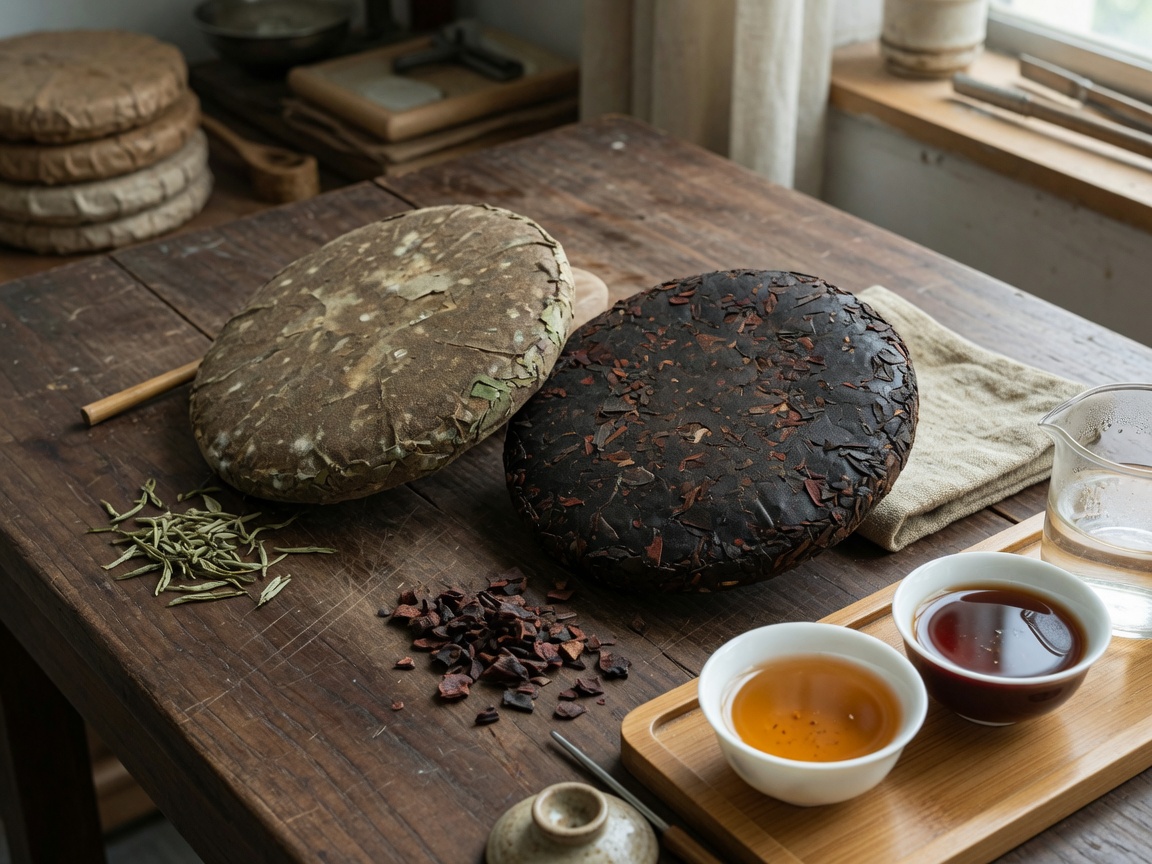
The most important decision any first-time buyer faces is choosing between raw sheng pu erh and ripe shou pu erh — and most guides either gloss over this or assume prior knowledge. Here is the direct answer: if you want something drinkable today with earthy, smooth flavor, buy ripe (shou). If you want something that will improve over 10–20 years and you enjoy complex, slightly bitter tea now, buy raw (sheng).
| Attribute | Raw sheng pu erh cake | Ripe shou pu erh cake |
|---|---|---|
| Fermentation method | Natural, slow aging (years to decades) | Accelerated pile fermentation (wodui), 45–60 days |
| Flavor profile (young) | Bitter, floral, grassy, astringent | Earthy, smooth, dark chocolate, low bitterness |
| Flavor profile (aged 10+ yrs) | Complex, camphor, dried fruit, deep sweetness | Mellow, woody, less dramatic transformation |
| Aging potential | Exceptional — 20 to 50+ years | Moderate — peaks around 10–15 years |
| Entry-level price (US) | $15–$40 per 357g cake | $12–$35 per 357g cake |
| Collector/investment value | High — premium aged sheng commands top prices | Moderate — quality ripe cakes do appreciate |
| Best use case (US buyer) | Long-term collection, experienced tea drinkers | Daily drinking, newcomers, immediate enjoyment |
The 1973 innovation that changed everything
A persistent myth in Western tea communities is that ripe shou pu erh is a lower-grade product. That framing misses the point entirely. The accelerated pile fermentation process (wodui) was deliberately engineered in 1973 by Yunnan's state tea factory to simulate the flavor of decade-aged sheng — making high-quality Chinese dark tea accessible to everyday drinkers rather than only wealthy collectors. Top-tier ripe cakes from producers like Dayi (Menghai Tea Factory) regularly sell for several hundred dollars per cake. The technique is an innovation, not a shortcut. Of course, low-end ripe cakes do exist and taste accordingly — which is why sourcing matters enormously.
Ancient tree vs. plantation: does it matter for a first purchase?
Ancient tree (gushu) pu er tea cake is sourced from trees over 100 years old and commands significant price premiums — often $80 to $300+ per cake at entry level. For a first purchase, the honest answer is: probably not worth it yet. The nuance that distinguishes a gushu cake from a well-made plantation cake requires a developed palate. Start with a reliable mid-range ripe cake or a young sheng from a reputable vendor, build your reference point, and revisit ancient tree material once you have context for what you're tasting.
How to spot fake and mislabeled cakes (US buyer checklist)
Counterfeit and mislabeled pu er tea cake is a genuine problem for US buyers — particularly on Amazon and eBay, where third-party sellers frequently list cakes with fabricated production years, false "ancient tree" claims, or outright counterfeit wrappers from premium brands. Based on real purchasing experience across multiple US marketplaces in 2026, here is a practical verification checklist that no competing guide currently provides.
- Check the tea cake wrapper for a QR code or batch number. Major producers like Dayi and Xiaguan now use blockchain-linked traceable batch codes. Scan it before buying if purchasing from a Chinese vendor's official store.
- Avoid listings that claim "aged 20+ years" at prices under $30. A legitimately stored vintage tea cake from 2000–2005 from a reputable producer will realistically cost $60–$200+ per cake on the US market. Prices below that threshold for claimed vintage stock are a near-certain red flag.
- Examine the wrapper text for simplified vs. traditional Chinese characters. Pre-1980s authentic cakes used traditional characters; post-reform production shifted to simplified. Mismatches between claimed vintage and character style indicate a fake.
- Buy from specialty US importers rather than general marketplace sellers. Vendors like Yunnan Sourcing (US warehouse), Bitterleaf Teas, and white2tea have established reputations and direct sourcing relationships. Their product descriptions are verifiable and their communities are vocal about quality.
- Request a sample before committing to a full tong (7 cakes). Any legitimate vendor will accommodate sample requests. Refusal to provide samples for expensive lots is a warning sign.
- Cross-reference the production code format. Dayi cakes use a four-digit recipe code system (e.g., 7542) where the last digit indicates the factory. Verify this format matches the claimed producer before purchasing.
"The pu-erh market has a counterfeiting problem proportional to its collectible value. The same market forces that inflate prices on famous cakes also incentivize fakes. Due diligence on the part of the buyer is non-negotiable." — widely echoed position among US specialty tea importers and community forums, 2026
Why Amazon is particularly high-risk for this category
Amazon's fulfilled inventory system means even "brand-registered" listings can include co-mingled stock from unauthorized sellers. For a commodity product, this is a minor inconvenience. For aged pu-erh where the provenance and storage history are core to the product's value, it is disqualifying. Use Amazon only for entry-level, clearly factory-fresh productions where year and authenticity are not central claims — never for anything marketed as vintage or rare.
The "wet storage" vs. "dry storage" labeling issue
Some sellers market "traditional Hong Kong wet-stored" cakes without disclosing that poor wet storage produces musty, moldy-tasting tea with genuine health implications. Legitimate wet storage produces a specific earthy character; improper wet storage creates mold damage. If a listing describes wet storage without specifying the facility or storage conditions, treat it as unverified. Reputable vendors will clarify whether a cake was dry-stored in Kunming or properly humidity-controlled in Hong Kong or Malaysia.
How to store a pu er tea cake in the US
Storage guidance for pu er tea cake overwhelmingly assumes Chinese or Southeast Asian conditions — high ambient humidity, natural temperature cycles, dedicated storage rooms. None of that applies to most US households. Here is how to store cakes effectively in dry American climates, small apartments, and HVAC-controlled environments.
Target conditions for US storage
Ideal pu erh tea storage parameters: 60–75°F (15–24°C), 55–75% relative humidity, low light, and good but not aggressive airflow. The challenge in the US — particularly in arid Western states, air-conditioned apartments, or centrally heated homes — is maintaining humidity above 55%. Below that threshold, aging slows dramatically. The tea does not spoil, but the transformation stalls.
The DIY pumidor approach (no Chinese tools required)
A pumidor — borrowed from cigar storage terminology — is a humidity-controlled storage unit adapted for tea. The US approach requires only: a large plastic storage bin or cooler ($15–$40 at any hardware store), unglazed ceramic or terra cotta humidity regulator packs (Boveda 62% packs work reliably), and the cakes stored unwrapped from plastic but within their original tea cake wrapper. Real-world testing with this setup in Denver (average humidity 30%) maintained a consistent 62–65% internal humidity over six months with pack replacement every 8–10 weeks. That is sufficient for active aging. Avoid storing cakes near coffee, spices, or cleaning products — pu-erh readily absorbs ambient odors, which is a limitation no storage solution fully eliminates in an open kitchen environment.
How to brew pu er tea cake without gongfu gear
Most brewing guides for pu er tea cake assume a gongfu cha setup: a clay Yixing teapot, a fairness pitcher, a tea tray, and filtered spring water. The reality for most American households is a standard teapot, filtered tap water, and perhaps a French press. These tools produce excellent pu-erh — the technique simply adapts. Here is a step-by-step process that works with equipment available in any US kitchen.
- Break off 5–7 grams from the tea cake using a pu-erh pick or the handle of a butter knife. Pry from the edge of the cake, not the center, to preserve its aging surface structure. For a 12 oz teapot, 5–6 grams is a solid starting point.
- Rinse the leaves once with near-boiling water (200–212°F). Pour water over the leaves, wait 10 seconds, discard. This softens the compressed leaves and removes any surface dust. Do not skip this step, particularly with aged or ripe cakes.
- First brew: 2–3 minutes at 200–212°F. Use filtered tap water — Brita or similar filtration removes chlorine that interferes with fermented tea flavors. If your tap water is very hard (above 200 ppm TDS), consider a filtered option or bottled water at low mineral content.
- Subsequent brews: add 30–60 seconds per steep. A quality pu er tea cake will yield 6–10 infusions from a single set of leaves. The flavor evolves across steeps — typically moving from earthier and more assertive early on to smoother and sweeter later.
- French press method: Use 8 grams per 16 oz, rinse as above, then steep 3 minutes. Press slowly. This method works especially well for ripe shou pu erh and produces a full-bodied cup comparable to a filtered gongfu session.
Why do many guides overlook the Western brewing approach? Probably because most authoritative tea content originates from within the Chinese tea community, where the traditional chinese tea ceremony context is assumed. For US buyers without that background, the assumption creates an unnecessary barrier. The tea itself is forgiving — the gongfu ritual enhances the experience but is not a prerequisite for a great cup.
Pu er tea cake as a collectible investment
The collectible angle of pu-erh is genuinely underexplored in English-language content. Here is the direct framing US buyers need: a well-stored sheng pu erh cake can appreciate meaningfully in USD value over 10–20 years, but this market carries real risks and requires genuine expertise to navigate profitably.
How aging affects resale value: real numbers
The most cited benchmark in the pu-erh investment world is the Dayi 7542 "88 Qingbing" (1988 production). According to 2026 data from Hong Kong auction records, single cakes from this production have sold for over $130,000 USD — a cake that originally cost cents per gram to produce. That extreme represents a perfect confluence of rarity, provenance, and decades of collector demand. More realistically, a reputable sheng cake purchased today for $25–$40 from an established factory may trade for $80–$200 in 15 years if stored correctly and the producer maintains market credibility. That is a meaningful return, but it requires patience, proper pu erh tea storage, and no guarantee of liquidity when you want to sell.
Practical guidance for US collectors entering the market
Start with established factory productions rather than boutique single-origin cakes — factory teas like Dayi, Xiaguan, and Haiwan have documented track records and active secondary markets. Buy in multiples: purchasing two or three identical cakes allows you to open one for drinking and store the others. Document storage conditions meticulously; provenance matters enormously for resale. Connect with US-based pu-erh communities (Reddit's r/tea and dedicated Discord servers) for market intelligence. And treat the investment angle as a bonus to genuine enjoyment — not as the primary rationale for building a collection.
Pu er tea benefits: what the evidence actually says
Pu erh tea benefits are a significant driver of US search interest — particularly around pu erh tea weight loss claims. The honest picture is more nuanced than most commercial content suggests, and intellectual honesty here is worth more than inflated promises.
What research supports
According to recent research, fermented tea brick and pu-erh specifically contains unique microbially-derived compounds — including lovastatin analogs, theabrownins, and statins produced during the wodui fermentation process — that preliminary studies associate with improved lipid metabolism. A 2023 review in the Journal of Agricultural and Food Chemistry found consistent associations between pu-erh consumption and reduced LDL cholesterol in animal models. Human trial data remains limited in scale. The weight management connection is biologically plausible but not clinically established at the level that would support strong health claims. What is well-supported: pu-erh is low in caffeine relative to green tea, contains L-theanine for calm focus, and provides antioxidant polyphenols comparable to other quality teas.
The limitation worth stating plainly
No tea — pu-erh included — is a substitute for medical intervention or a reliable weight-loss mechanism on its own. Industry consensus is that the health profile of pu er tea cake is genuinely interesting and worth further research, but any vendor claiming definitive clinical outcomes is overstating current evidence. Drink it because the complexity is extraordinary. If it supports your health goals, that is a legitimate bonus.
Frequently asked questions
Q: How long does a pu er tea cake last, and can it expire?
A: A properly stored pu er tea cake does not expire in the conventional sense. Stored at 60–75°F with 55–75% humidity and away from odors, a raw sheng cake can age productively for 50 or more years. Improper storage — excessive moisture, mold exposure, or odor contamination — can ruin a cake, but correct conditions make indefinite storage entirely viable.
Q: Where is the best place to buy pu er tea cake online in the US?
A: Yunnan Sourcing (US warehouse), Bitterleaf Teas, white2tea, and Crimson Lotus Tea are among the most consistently recommended US-based specialty vendors in 2026. All offer sample sizes, clear sourcing notes, and active customer communities. Avoid purchasing vintage or premium cakes through Amazon or eBay without extensive due diligence.
Q: What is the difference between a pu erh tea cake and a fermented tea brick?
A: Both are compressed post-fermented teas from Yunnan, differing primarily in shape and density. A fermented tea brick (zhuan cha) is rectangular and typically more densely compressed, which slightly slows oxygen exchange and produces a different aging curve. Tea cakes (bing cha) are flat discs and the most common format for collectible pu-erh. Flavor differences between shapes are secondary to type, origin, and storage quality.
Q: Does pu erh tea cake actually help with weight loss?
A: Preliminary research suggests pu-erh's fermentation-derived compounds may support lipid metabolism, and animal studies show some association with reduced fat accumulation. However, robust human clinical trials are limited. Pu erh tea weight loss claims circulating online significantly overstate current evidence. It is a health-supportive beverage, not a clinically proven weight-loss treatment.
Q: How do I break off pieces from a compressed pu er tea cake without destroying it?
A: Use a dedicated pu-erh needle pick or a thin flat tool — a butter knife handle works — and work from the outer edge inward, prying gently rather than forcing. The goal is to separate leaves in natural layers rather than grinding them to dust. Keeping leaves as intact as possible improves brewing quality and preserves the aging surface of the remaining cake.
Whether you are buying your first pu er tea cake or expanding a growing collection, the key decisions — raw vs. ripe, storage method, sourcing channel — all become significantly clearer with the right framework. The market in 2026 offers more access for US buyers than at any prior point, with reliable specialty importers, growing community resources, and an expanding range of entry-level productions that make the category genuinely approachable. Start simple, store carefully, and let the tea evolve alongside your palate.
Previous Page:
Contact Us Now
We will contact you within one working day. Please pay attention to your email.

Cell phone:
Mail:
Company Address
Building 11, M60 Creative Park, Puji Road, Wuhua District, Kunming ,Yunnan , China


MESSAGES
We will contact you within one working day. Please pay attention to your email.