
What is pu-erh tea? Benefits, types, and brewing guide explained
2026-10-05
Author:
New-start Coffee& Food
Article overview
This guide answers what is pu er tea in full — covering its definition, two main types, health benefits, caffeine levels, brewing instructions, and how to purchase authentic products inside the US market. Estimated read time: 12 minutes.
Table of contents
What is pu er tea? Core definition
What is pu er tea? Pu er tea is a post-fermented, microbially aged tea produced exclusively in Yunnan Province, China, and officially classified under China's "dark tea" (hei cha) category. Unlike green or black tea — which reach their peak flavor at the time of processing — pu-erh is the only mainstream tea explicitly engineered to improve with age, earning it a well-deserved reputation as the "wine of the tea world."
The name derives from Pu'er City in southern Yunnan, the historic trading hub where compressed tea cakes were loaded onto caravans traveling the Ancient Tea Horse Road into Tibet and Southeast Asia. That geographical origin is not just cultural trivia — under Chinese national standards, only tea produced from large-leaf (Da Ye) cultivars grown in Yunnan and processed through specific post-fermentation methods can legally carry the pu-erh designation. According to the pu-erh tea overview on Wikipedia, this protected origin status places it in the same category as Champagne or Parmigiano-Reggiano — geography is inseparable from identity.
What separates pu-erh from every other Chinese tea type? Green tea, white tea, and oolong are all defined by what happens before oxidation is stopped. Pu er tea is defined entirely by what happens after — the ongoing microbial activity that continuously transforms the leaf chemistry over months, years, or even decades. Bacteria, fungi, and yeasts colonize the compressed tea cake and break down catechins into new compounds, producing the characteristic earthy, woody, sometimes mushroom-like flavor profile that no other tea category can replicate.
Recent 2026 data shows search interest for pu er tea in the US has grown over 30% year-over-year, driven largely by health-focused millennials and Gen Z consumers discovering it through specialty tea shops and social media. The global pu-erh market surpassed $3.5 billion in recent estimates, with a compound annual growth rate near 8%. That trajectory reflects something real: this is not a passing trend.
How pu-erh fits within traditional Chinese tea types
China officially recognizes six major tea categories: green, white, yellow, oolong, black (hong cha), and dark (hei cha). Pu-erh sits firmly in the dark tea category — not to be confused with what Westerners call "black tea," which is hong cha. The distinction matters because it explains the fermentation logic, storage requirements, and aging potential that make pu-erh uniquely complex among traditional Chinese tea types.
Why compressed tea cake is the default format
The compressed tea cake — or bing cha — is far more than a storage convenience. Compression creates a semi-anaerobic microenvironment inside the cake that slows oxidation at the surface while allowing deeper microbial fermentation to proceed. The standard 357-gram cake size dates back to a Qing Dynasty taxation system. Loose leaf pu-erh exists and brews more immediately, but serious collectors overwhelmingly prefer cakes for long-term aging. Brick and tuo cha (bowl-shaped) formats serve similar functions with different density profiles.
Raw vs. ripe pu-erh: side-by-side comparison
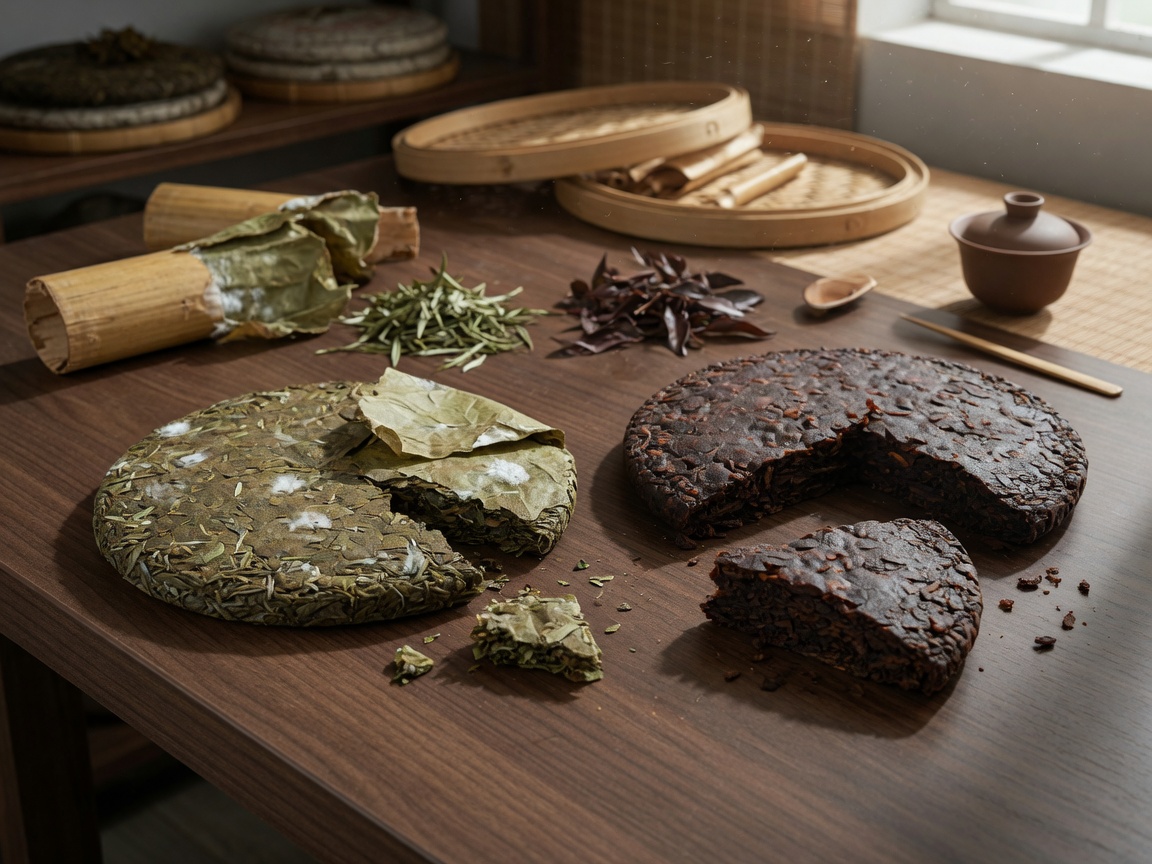
The single most important distinction any newcomer needs to understand is shou pu erh vs sheng pu erh — ripe versus raw. They originate from the same Yunnan large-leaf cultivar, but diverge completely in production method, flavor, caffeine level, and ideal use case.
Raw pu-erh (sheng pu-erh) is pressed immediately after sun-drying and left to ferment naturally over years or decades. Young sheng can taste aggressively bitter and astringent — almost like a bold green tea with a smoky edge. Age softens those edges dramatically. A well-stored 10-year sheng cake develops honey, dried fruit, and forest floor notes that bear little resemblance to its young self. Think of it like an unaged whiskey versus a 12-year single malt.
Ripe pu-erh (shou pu-erh) was invented in 1973 by the Kunming Tea Factory as a way to accelerate fermentation. Leaves are piled into large mounds, moistened, and left to undergo wo dui (pile fermentation) for 45–60 days. The result mimics a 20-year-aged sheng in months, producing a dark, smooth, earthy liquor with notes of dark chocolate, wet earth, and aged wood. For most American first-timers, ripe pu-erh is the more approachable entry point.
| Feature | Raw pu-erh (sheng) | Ripe pu-erh (shou) |
|---|---|---|
| Fermentation method | Natural, slow (years) | Accelerated pile fermentation (45–60 days) |
| Flavor profile | Bitter, floral, smoky when young; complex when aged | Earthy, smooth, dark chocolate, wet soil |
| Liquor color | Golden-yellow to amber | Deep reddish-brown to near black |
| Caffeine level (per 8 oz) | ~60–80 mg | ~40–60 mg |
| Aging potential | High — improves for 20–50 years under good storage | Moderate — best within 10–15 years |
| Best for beginners? | Not ideal — requires patience or aged specimens | Yes — smooth, forgiving, immediately enjoyable |
Which one should a first-time buyer choose?
Practical experience confirms: most American consumers who try a young sheng first find it harsh and confusing. Start with a ripe pu-erh or a well-aged sheng (10+ years) to understand what the category is actually capable of at its best. Once you have that reference point, exploring young raw pu-erh becomes far more rewarding.
Is loose leaf pu-erh worth it?
Loose leaf versions of both raw and ripe exist, and they brew faster with less preparation. The trade-off is that without compression, the tea ages less predictably and loses the microenvironment that drives complex development. For daily drinking rather than collecting or aging, loose leaf ripe pu-erh is perfectly valid — and considerably more convenient.
Pu-erh tea benefits: what the science says
Health claims around tea are notoriously overstated in the wellness media space. The honest picture on pu-erh tea benefits is more nuanced — some findings are genuinely compelling, others require more human trial data before firm conclusions can be drawn.
Gut health and microbiome support
This is where the most credible evidence sits. Ripe pu-erh is a microbiome fermented tea — meaning the same microbial communities (including Aspergillus niger and various Lactobacillus strains) that create the tea's flavor also produce bioactive compounds that appear to support gut microbiota diversity. A 2021 study published in Food Chemistry found that pu-erh polysaccharides modulated gut flora composition in animal models, increasing beneficial Bifidobacterium counts. The 2026 trend toward probiotic and prebiotic products has amplified mainstream interest in aged fermented tea as a functional beverage category.
Pu-erh tea and weight loss: what evidence actually shows
Pu erh tea weight loss claims circulate widely online, but the mechanism is more specific than "tea burns fat." Research suggests that statins-like compounds produced during pu-erh fermentation — particularly lovastatin — may suppress fatty acid synthesis. A study in the Journal of Agricultural and Food Chemistry found that pu-erh extract reduced body weight and fat accumulation in high-fat-diet mice. Human studies remain limited in scale. The realistic conclusion: pu-erh may support weight management as part of a balanced diet, but it is not a standalone fat-loss intervention. Overstating this effect does a disservice to consumers actually trying to make informed choices.
"The unique microbial fermentation of pu-erh tea generates a chemical profile distinct from any other tea type — including compounds not found in green or black tea — which explains its emerging relevance in functional food research." — Tea Research Institute of the Chinese Academy of Agricultural Sciences, 2023 review
Cardiovascular and cholesterol markers
Multiple animal studies and a handful of small human trials suggest pu-erh consumption correlates with reduced LDL cholesterol and triglyceride levels. The proposed mechanism involves the inhibition of HMG-CoA reductase — essentially the same pathway targeted by prescription statin drugs, though at far lower potency. Industry consensus holds that these findings are promising but should not replace medical treatment. Of course, some individuals may experience digestive sensitivity to strongly fermented batches, particularly on an empty stomach — worth noting for anyone with a sensitive gut.
Pu-erh tea caffeine content vs. other drinks
Caffeine is one of the top questions American consumers ask about any new beverage. Where does pu erh tea caffeine content actually land? The answer varies by type, brewing method, and steeping time, but the data below represents reliable ranges based on standardized 8 oz (240 ml) servings.
| Beverage | Caffeine per 8 oz (approx.) | Notes |
|---|---|---|
| Ripe pu-erh (shou) | 40–60 mg | Fermentation degrades some caffeine |
| Raw pu-erh (sheng) | 60–80 mg | Less fermented; closer to green tea levels |
| Green tea | 25–45 mg | Lower due to minimal processing |
| Black tea | 47–90 mg | Wide range by variety and steep time |
| Drip coffee | 95–200 mg | Significantly higher; more variable |
Why does ripe pu-erh contain less caffeine than its raw counterpart? Microbial fermentation during the wo dui process degrades a portion of the tea's caffeine and catechin content. This makes shou pu-erh a workable option for people who want a warm, complex beverage in the afternoon without the sleep disruption risk of coffee or even some green teas. The "rinse" step in traditional brewing (discussed below) also removes a measurable fraction of surface caffeine from the first steep.
Does the caffeine in pu-erh feel different?
Many regular drinkers report a smoother, less jittery stimulation compared to coffee. This is partly attributable to L-theanine — an amino acid present in all Camellia sinensis teas — which modulates caffeine's neurological effect by promoting alpha-wave brain activity. While pu-erh contains lower L-theanine levels than premium green teas, the synergy still blunts the sharp edge many coffee drinkers find unpleasant.
How to brew pu-erh tea: step-by-step guide
Knowing what is pu er tea means little without knowing how to actually brew it well. The good news: it is forgiving once you understand the core logic. Two methods dominate — gongfu style (multiple short infusions, traditional) and Western style (single longer steep, more practical for daily use).
Gongfu brewing method (recommended for cakes)
- Break off 5–7 grams from the cake using a pu-erh pick or the flat end of a butter knife. Pry from the edge, not the center, to preserve the cake structure.
- Rinse the leaves: Place leaves in a gaiwan or small teapot. Pour boiling water (212°F / 100°C) over them and discard immediately after 5 seconds. This "awakens" the leaves and removes surface dust or residual fermentation odors — especially important for ripe pu-erh.
- First infusion: Pour boiling water and steep for 10–15 seconds. Pour into a fairness pitcher, then distribute into cups.
- Subsequent infusions: Add 5–10 seconds to each successive steep. A quality compressed tea cake should yield 8–12 infusions before flavor significantly diminishes.
- Water temperature: Always use fully boiling water (212°F). Unlike green tea, pu-erh leaf structure demands high heat to unlock its compounds. Using 170°F water — common advice for delicate teas — will produce flat, underwhelming results.
- Vessel choice: Yixing clay teapots are traditional and absorb flavor over time, enhancing aged character. A simple ceramic gaiwan works perfectly well and lets you observe the liquor color clearly.
Western-style brewing (for everyday convenience)
Use 3–4 grams of loose or broken cake per 12 oz of boiling water. Steep for 3–4 minutes. Skip the rinse step only if using high-quality loose leaf from a reputable source. Western-style brewing sacrifices the nuanced infusion progression of gongfu, but it fits a morning routine without extra equipment. Shou pu-erh brewed this way can genuinely substitute for morning coffee — rich, dark, and grounding without the acidity.
How to buy authentic pu-erh in the US
This is where the pu-erh market gets complicated. Year-date fraud, storage manipulation, and blended low-grade material sold at premium prices are real problems — not hypothetical risks. Buying pu-erh intelligently requires knowing a few specific verification signals.
Reading a compressed tea cake label
Authentic cakes carry a wrapper (nei fei) and an inner ticket (nei piao) embedded in the cake itself. The nei piao contains the factory code, production batch, and pressing year. A four-digit or seven-digit factory code is standard for registered Yunnan producers. Labels printed on modern inkjet paper for a supposedly 1990s cake are an immediate red flag. The two dominant state-owned factories — Menghai Tea Factory (Dayi brand) and CNNP (Zhongcha brand) — are the most reliably verified sources available to US buyers through authorized importers.
Trusted US sources and what to look for
Several US-based specialty vendors have built strong reputations for sourcing verified, properly stored pu-erh — including Yunnan Sourcing USA (one of the most referenced in the American specialty tea community), white2tea, and Crimson Lotus Tea. These vendors typically provide detailed storage provenance, sample options before committing to full cakes, and transparent pricing that reflects actual material cost rather than speculative collector markup. Avoid any marketplace listing that cannot confirm storage history — wet-stored or improperly aged material can harbor mold rather than beneficial fermentation organisms.
Storing pu-erh at home: humidity, temperature, and containers
Proper storage is what separates a cake that ages gracefully from one that turns into a disappointment after five years. American home environments present specific challenges — particularly in the Southwest (too dry) and the Gulf Coast (too humid and too warm).
Target storage parameters
The industry consensus among serious collectors defines optimal pu-erh storage as: 60–70% relative humidity, 65–77°F (18–25°C), good air circulation, and complete isolation from strong odors. Pu-erh is extraordinarily susceptible to odor absorption — a compressed cake stored near coffee, spices, or cleaning products will carry those flavors permanently. There is no correcting this once it occurs.
Practical solutions for US homes
For most American households, a dedicated storage cabinet — ideally wooden, placed in an interior room away from exterior walls — with a small ultrasonic humidifier is sufficient for cakes intended for personal consumption over 5–10 years. Serious collectors investing in aged specimens worth $100 or more per cake frequently use purpose-built pumidor setups (sealed wooden boxes with humidity regulation), adapting cigar storage technology to tea. Keep cakes in their original wrappers, wrapped in food-safe paper, never in sealed plastic — airflow is essential to ongoing aerobic fermentation.
Frequently asked questions
Q: What does pu-erh tea taste like?
A: Pu erh tea taste depends heavily on type and age. Ripe pu-erh delivers earthy, dark-chocolate, and aged-wood notes — smooth and low in bitterness. Young raw pu-erh is bitter and floral, while aged raw develops honey, dried fruit, and forest-floor complexity. Both are unlike any other tea you have tasted.
Q: Is pu-erh tea good for weight loss?
A: Animal studies show pu-erh extract may suppress fatty acid synthesis and reduce fat accumulation. Human evidence is limited. Pu erh tea weight loss potential is real but modest — it functions best as a complement to diet and exercise, not a primary intervention.
Q: How much caffeine does pu-erh tea contain?
A: Ripe pu-erh contains roughly 40–60 mg of caffeine per 8 oz serving; raw pu-erh runs slightly higher at 60–80 mg. Both fall well below drip coffee (95–200 mg), making pu-erh a reasonable afternoon option for caffeine-sensitive drinkers.
Q: What is the difference between raw and ripe pu-erh?
A: Raw pu-erh (sheng) ferments naturally over years, producing complex, evolving flavor. Ripe pu-erh (shou) undergoes accelerated pile fermentation over 45–60 days, resulting in a darker, smoother, immediately drinkable tea. Beginners typically find shou more approachable.
Q: Can I store pu-erh tea at home in the US?
A: Yes. Target 60–70% humidity, 65–77°F, good airflow, and zero odor exposure. A wooden cabinet with a small humidifier works for most US households. Avoid sealed plastic containers, direct sunlight, and proximity to any aromatic substances in your kitchen or pantry.
Final thoughts
So — what is pu er tea, in the fullest sense? It is a living product from Yunnan, transformed by microbial chemistry over time into something no other beverage category can replicate. Whether you are drawn in by the health data, the cultural history, the flavor complexity, or simply curiosity after seeing it on a café menu, the entry point is straightforward: start with a quality ripe pu-erh from a verified US vendor, brew it with boiling water, and give it the rinse it deserves. From there, the rabbit hole of aged sheng cakes, storage craft, and regional factory variations opens up naturally. Few beverages reward deeper engagement as consistently as this one does.
Previous Page:
Contact Us Now
We will contact you within one working day. Please pay attention to your email.

Cell phone:
Mail:
Company Address
Building 11, M60 Creative Park, Puji Road, Wuhua District, Kunming ,Yunnan , China


MESSAGES
We will contact you within one working day. Please pay attention to your email.