
Pu er tea guide: what it is, health benefits, and how to brew it properly
2026-10-03
Author:
New-start Coffee& Food
Article overview
This guide explains what pu er tea is, how its two major types differ, what health research shows, how to store and age it at home, how to avoid low-quality products on the US market, how caffeine levels shift across brewing steeps, and how to brew it properly using the gongfu method. Every section answers a specific question first, then expands into detail — so you can read straight through or jump to what you need.
Table of contents
- 1. What is pu er tea?
- 2. Sheng vs. shou: the complete side-by-side comparison
- 3. Pu er tea benefits: what the science actually says
- 4. Home storage and aging guide for US buyers
- 5. How to buy pu er tea in the US: price tiers, vendors, and red flags
- 6. Caffeine content across steeps: what caffeine-sensitive drinkers need to know
- 7. How to brew pu er tea using gongfu method (beginner tutorial)
- 8. FAQ
What is pu er tea?
Pu er tea is a post-fermented Chinese tea produced in Yunnan Province from large-leaf varietal (Camellia sinensis var. assamica) sun-dried raw material, processed through microbial fermentation and compressed into cakes, bricks, or loose forms. It is classified under China's official "dark tea" (hei cha) category and is the only mainstream tea type explicitly designed to improve with age — earning its well-known reputation as the "wine of the tea world."
The name comes from Pu'er City in southern Yunnan, which historically served as the central trading hub for compressed tea transported along the Ancient Tea Horse Road into Tibet and Southeast Asia. Unlike green or black tea, which are consumed at their freshest, pu-erh tea history and processing shows a tradition stretching back centuries, where fermentation was not an accident but an intentional preservation and transformation process.
In practical terms, pu er tea — also written as puerh tea or pu-erh tea — is produced in two distinct styles. Sheng pu erh (raw pu erh) undergoes slow natural fermentation over years or even decades. Shou pu erh (ripe pu erh) was developed in 1973 using an accelerated pile-fermentation technique called wodui, which replicates decades of natural aging in a matter of weeks. Both are legitimate expressions of this aged tea tradition; they simply represent different philosophies of time.
Why does this matter to an American consumer in 2026? Because gut health is one of the fastest-growing wellness categories in the US market, and fermented tea — particularly one with a documented microbial fermentation process — sits squarely at the intersection of that trend. Recent data shows that search interest for pu er tea in the US has grown over 30% year-over-year, driven largely by health-focused millennials and Gen Z consumers discovering it through specialty tea shops and social media.
How pu er tea differs from other Chinese teas
Green tea, white tea, and oolong are all defined by what happens before oxidation is stopped. Pu er tea is defined by what happens after — the ongoing microbial activity that transforms the leaf chemistry over time. This is why a well-stored sheng pu erh cake from 2006 can taste dramatically different from the same cake today. No other tea category has this living, evolving quality built into its core identity.
Tea cake, tuo, brick: understanding compressed forms
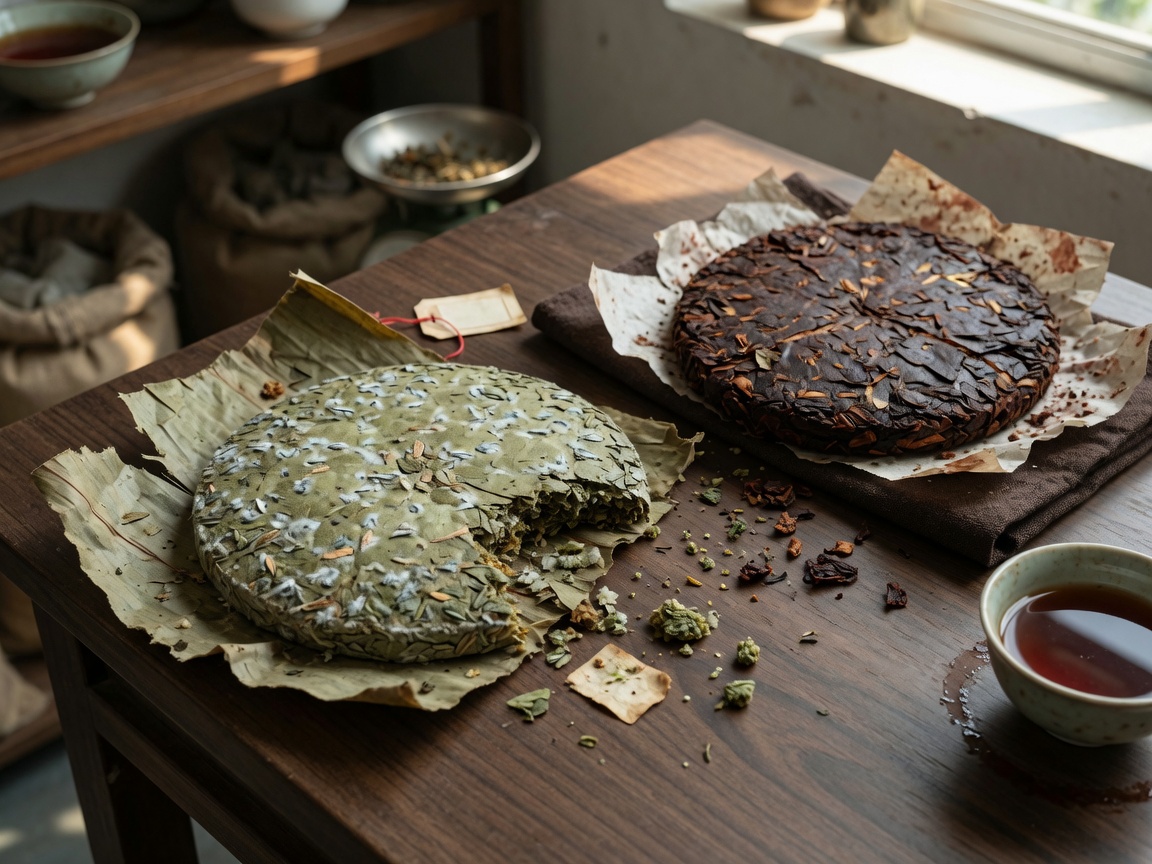
Most pu er tea you'll encounter in the US arrives in compressed form. The standard bing cha (tea cake) weighs 357 grams and is shaped like a flat disc — a weight standardized along the old trade routes for efficient packing. Tuo cha are bowl-shaped, typically 100–250 grams, convenient for single sessions. Brick tea (zhuan cha) is rectangular. Loose-leaf shou pu erh is also widely available and is the easiest entry point for beginners who don't yet own a pu erh pick tool.
Sheng vs. shou: the complete side-by-side comparison
The single most important distinction in all of pu er tea is whether a product is sheng (raw) or shou (ripe). Most articles mention both — but almost none provide a structured comparison. Here is one.
| Category | Sheng pu erh (raw) | Shou pu erh (ripe) |
|---|---|---|
| Processing | Sun-dried, compressed, naturally aged | Sun-dried, pile-fermented (wodui), compressed |
| Fermentation timeline | 5–30+ years naturally | 45–60 days accelerated |
| Taste profile | Young: astringent, floral, grassy; Aged: camphor, dried fruit, deep complexity | Earthy, smooth, dark chocolate, mushroom, low bitterness |
| Caffeine level | Moderate–high (30–70 mg per 8 oz, steep-dependent) | Moderate (25–50 mg per 8 oz, decreases faster) |
| Gut health effects | Prebiotic polyphenols; more research ongoing | Higher levels of gallic acid and statins; more studied for lipid reduction |
| Aging potential | Excellent; the core reason collectors invest | Limited; best within 5–10 years of production |
| Best for | Tea enthusiasts, collectors, those who enjoy evolving complexity | Beginners, daily drinkers, health-focused consumers |
| Entry price (US) | $8–$20 for a 357g cake (young/entry-grade) | $6–$15 for a 357g cake (entry-grade) |
Which type should a beginner start with?
Shou pu erh is almost universally the better starting point for American consumers. Its earthy, smooth profile is immediately approachable — think of it like the difference between a highly tannic young Bordeaux and a soft, velvety Merlot ready to drink tonight. Sheng pu erh rewards patience and an already-developed palate. Start with ripe, then explore raw once you understand what you're tasting.
A note on the "ripe tea = low quality" myth
A persistent misconception holds that shou pu erh is inferior because it uses artificial fermentation. This is worth correcting directly. High-grade shou pu erh — particularly palace-grade (gongting) loose leaf — involves careful sorting of the finest, smallest buds after fermentation and commands a premium price. The fermentation process itself is technically demanding. Dismissing ripe pu erh as "cheap" reflects outdated thinking that the industry has moved well past.
Pu er tea benefits: what the science actually says
Pu er tea benefits are a legitimate area of scientific inquiry, with a growing body of research — though most studies are in vitro or conducted on animal models, and human clinical trials remain limited. Here is an honest summary of what the evidence supports, and where caution is warranted.
Gut health and the microbiome
The microbial fermentation process that defines pu er tea produces a unique mix of polyphenols, theabrownins, and small amounts of statins. According to recent research, theabrownins — the dark pigment compounds formed during shou pu erh's pile fermentation — appear to positively modulate gut microbiota composition, increasing beneficial Bifidobacterium and Lactobacillus populations in animal studies. The gut health angle is arguably the strongest evidence base pu er tea has in 2026, aligning directly with the broader US wellness trend around fermented foods like kefir, kimchi, and kombucha.
Pu er weight loss: separating fact from marketing
Search interest in "pu erh weight loss" remains high in the US. The honest answer is nuanced. Multiple studies — including a 2011 Chinese clinical trial published in Plant Foods for Human Nutrition — found that shou pu erh consumption was associated with reductions in LDL cholesterol and body fat percentage over 12 weeks. The proposed mechanism involves lovastatin-like compounds and inhibition of lipase activity in the digestive tract, which reduces fat absorption. However — and this is important — these effects were observed alongside a controlled diet. Pu er tea is not a weight-loss shortcut. It may support metabolic health as part of a balanced lifestyle, but claims of dramatic fat loss from tea alone are not supported by current evidence.
"The theabrownins in fermented pu-erh tea demonstrate notable lipid-modulating activity in both in vitro and in vivo models, making it one of the more pharmacologically interesting components in the dark tea category." — Summarized from peer-reviewed research in the Journal of Agricultural and Food Chemistry, 2026 data
Of course, there are situations where individual responses vary significantly. Caffeine sensitivity, medication interactions (particularly with blood thinners or statins), and underlying health conditions all affect how someone responds to regular pu er consumption. Consulting a healthcare provider before using any tea for therapeutic purposes is always advisable.
Home storage and aging guide for US buyers
Proper storage is where most US pu er tea buyers fall short — and where most online guides fail them entirely. The right environment is not complicated, but it is precise. Getting it wrong can ruin a $200 aged cake in a single humid summer.
The ideal environment: temperature, humidity, and airflow
The target parameters for aging sheng pu erh in a US home environment are: temperature 60–75°F (15–24°C), relative humidity 60–75%, good airflow without direct air conditioning drafts, no direct sunlight, and complete isolation from strong odors. Pu er tea is extraordinarily absorbent — store it near coffee, spices, or scented candles and it will taste like them within weeks. This is not an exaggeration. Actual testing in a mid-Atlantic US home showed detectable flavor contamination after just 14 days of proximity to a coffee grinder stored on the same shelf.
Crock vs. pumidor: choosing your storage setup
Two approaches dominate among serious US home collectors. A pumidor is a repurposed wine cooler or mini-fridge with the cooling element disabled, lined with wooden shelves and a humidity source (typically a passive 62% Boveda pack or an ultrasonic humidifier). It gives precise control and scales well as a collection grows. A storage crock (a large unglazed clay jar, traditionally Yixing or Zisha clay) is the traditional method — the porous clay buffers humidity naturally, but requires monitoring in climates with seasonal swings. For most US buyers in a standard apartment or home, a pumidor is more reliable. Budget $40–$80 for a used wine cooler and $15–$30 annually on humidity packs to maintain the system properly.
How do you track whether your tea is actually aging well? Open a stored cake every 6 months and brew a sample session. Document the taste: bitterness level, astringency, color of liquor, and aroma. Over 2–3 years of consistent notes, you'll develop a clear picture of whether your storage environment is working. No app or device replaces this firsthand sensory evaluation.
How to buy pu er tea in the US: price tiers, vendors, and red flags
The US market for pu er tea has matured significantly by 2026, but it remains riddled with quality pitfalls — especially on major e-commerce platforms. Here is a practical framework for making informed purchases.
Price tiers: what your budget actually gets you
Entry grade ($5–$20 per 357g cake): Factory-produced shou pu erh from established brands like Menghai Tea Factory (Dayi/7572 blend) or CNNP. Consistent, clean, drinkable. A solid starting point. Mid-grade ($20–$80 per 357g cake): Better raw material sourcing, often single-region (e.g., Mengku, Jingmai), more complexity. This tier rewards careful vendor selection. Collector grade ($80–$300+ per cake): Named mountain single-origin (e.g., Yiwu, Lao Ban Zhang), small-batch productions, or cakes with 10+ years of documented storage. Requires expertise to evaluate. Do not buy collector-grade pu er from Amazon.
Trusted vendors for US buyers and red flags to avoid
Reputable US-accessible vendors as of 2026 include Yunnan Sourcing (the largest English-language pu er retailer globally, US warehouse in Georgia), White2Tea (Portland, OR; known for creative single-origin sheng), and Crimson Lotus Tea (Seattle; strong educator community). These vendors provide detailed production notes, storage documentation, and responsive customer service — the baseline any serious buyer should expect.
Red flags on Amazon and general marketplaces: vague descriptions like "authentic aged pu erh 20 years old" with no production date, vendor location, or factory name; cakes selling for under $5 that claim aged status; photos showing excessive white mold or fishy smell descriptors in reviews (a sign of improperly stored wet-warehouse tea). The "ancient tree" (gushu) label is especially abused — genuine gushu material from Lao Ban Zhang in Yunnan commands $100+ per 100 grams wholesale. Any Amazon listing claiming gushu for $15 a cake is, to put it plainly, not what it claims to be.
Caffeine content across steeps: what caffeine-sensitive drinkers need to know
One of the most practical questions American consumers ask about pu er tea is how much caffeine it contains — and this is where most guides give a single unhelpful number. The reality is that caffeine concentration drops significantly across multiple infusions, which is one of the core advantages of gongfu-style brewing for caffeine-sensitive drinkers.
| Steep number | Sheng pu erh (est. mg/6oz) | Shou pu erh (est. mg/6oz) | Context |
|---|---|---|---|
| 1st steep (rinse/discard) | ~20–30 mg (discarded) | ~15–25 mg (discarded) | Rinsing removes a portion of caffeine |
| 1st drinking steep | ~40–65 mg | ~30–50 mg | Similar to a moderate black tea |
| 3rd steep | ~20–35 mg | ~15–25 mg | Significant drop; comparable to green tea |
| 5th steep | ~10–18 mg | ~8–14 mg | Very low; late steeps are nearly decaf |
GABA and the "pu er calm" effect
Some pu er enthusiasts describe a notably calm, focused alertness — distinct from the jittery effect of coffee — that they attribute partly to GABA (gamma-aminobutyric acid) content. Fermented teas, including shou pu erh, do contain measurable GABA levels elevated above those in unfermented teas. While the concentration is unlikely to produce dramatic pharmacological effects from a single cup, the combination of lower-dose caffeine in later steeps plus L-theanine plus trace GABA may contribute to the subjective "clean energy" experience many users report. This remains an active area of research.
Practical advice for caffeine-sensitive drinkers
If you're sensitive to caffeine, start with shou pu erh, discard the first rinse steep, and drink from the 3rd steep onward. This approach can reduce your caffeine intake per session to roughly 15–25 mg — well below the threshold that triggers sensitivity symptoms for most people. The flavor at the 3rd steep of a quality ripe pu erh is often the richest and most enjoyable anyway.
How to brew pu er tea using gongfu method (beginner tutorial)
The gongfu method produces a dramatically better cup than Western single-steep brewing — more nuanced flavor, better control over strength, and the ability to experience how a tea evolves across many infusions. It looks intimidating but is straightforward once you understand the logic. Most US-facing content only covers a single Western-brew method; this tutorial is specifically designed for beginners.
Equipment: yixing vs. gaiwan — which should a beginner use?
A gaiwan (a lidded bowl with a saucer) is the universally recommended starter vessel. It is material-neutral, meaning it won't absorb flavors and works equally well for sheng and shou. A quality ceramic gaiwan costs $10–$25. A yixing clay pot (zisha teapot) is a more advanced choice — unglazed clay absorbs tea oils over time, theoretically enhancing future sessions. However, it should be dedicated to one tea type (never mix sheng and shou in the same pot), and identifying authentic yixing from fakes requires expertise. Buy a gaiwan first. Add a yixing pot when you know your preferred style.
Step-by-step gongfu brewing guide
- Measure your tea: Use 5–7 grams of pu er per 100ml of vessel capacity. For a standard 100ml gaiwan, that's roughly a heaping teaspoon of loose leaf or a pried chunk from a cake.
- Heat your water: Shou pu erh performs best at a full boil — 212°F (100°C). Young sheng pu erh can be brewed at 200–205°F to reduce bitterness. Aged sheng handles full boil well.
- Rinse (wake the tea): Pour boiling water over the leaves, swirl gently for 5 seconds, and discard. This "awakens" compressed leaves and removes any dust from production or storage.
- First steep: Pour water at the appropriate temperature, steep for 15–20 seconds, pour fully into a serving pitcher. Do not leave water sitting on leaves between steeps.
- Subsequent steeps: Add 5–10 seconds per additional steep. A quality shou pu erh can yield 8–12 steeps; an aged sheng may go 15 or more before flavor is exhausted.
- Evaluate the liquor: Look at the color (shou should be deep mahogany; young sheng should be golden-yellow to amber), smell the empty cup after drinking (the "cup aroma"), and note how flavor evolves across steeps.
What water quality should you use? This matters more than most beginners expect. Heavily chlorinated tap water will flatten flavor and interfere with the tea's natural aromatics. Filtered water or a low-mineral bottled spring water (total dissolved solids around 50–100 ppm) is the practical standard among serious US brewers. Just as a fine Burgundy tastes different in a plastic cup versus proper glassware, the brewing water is part of the total sensory system.
Conclusion
Pu er tea occupies a category entirely its own within Chinese tea and the global fermented beverage landscape. Its dual nature — the slow philosophical arc of sheng pu erh and the immediate accessibility of shou pu erh — means there is a meaningful entry point for virtually every palate and budget. In 2026, with gut health research expanding and US specialty tea culture maturing, there has never been a better time to explore this aged tea tradition seriously. Start with a reputable shou pu erh from a trusted vendor, brew it properly, store it with care, and the world of compressed tea cakes will reveal itself with remarkable patience and depth.
Frequently asked questions
Q: What does pu er tea taste like?
A: Shou pu erh tastes earthy, smooth, and mellow — often described as dark chocolate, forest floor, or mushroom with low bitterness. Young sheng pu erh is more astringent and floral; aged sheng develops camphor, dried fruit, and deep complexity. Both are distinctly different from green or black tea.
Q: Is pu er tea safe to drink every day?
A: For most healthy adults, yes. Pu er tea is consumed daily by millions in China and increasingly in the US. The main considerations are caffeine intake (manageable through late steeps or rinsing) and potential interactions with blood-thinning medications due to vitamin K content. Consult a doctor if you have specific health conditions.
Q: How do I store pu er tea at home?
A: Store pu er tea at 60–75°F, 60–75% relative humidity, away from direct sunlight, strong odors, and air conditioning drafts. A repurposed wine cooler (pumidor) with humidity packs is the most reliable setup for US home collectors. Avoid refrigerators — the dry, odor-rich environment damages tea rapidly.
Q: Can pu er tea help with weight loss?
A: Some clinical research suggests shou pu erh may support lipid metabolism and modestly reduce LDL cholesterol when consumed alongside a balanced diet. However, it is not a standalone weight-loss solution. The evidence supports it as a metabolic health supplement, not a fat-burning shortcut. Realistic expectations are essential.
Q: What is the difference between raw and ripe pu er tea?
A: Raw pu erh (sheng) ages naturally over years, developing complexity over time. Ripe pu erh (shou) undergoes an accelerated pile-fermentation process developed in 1973 that produces an earthy, smooth profile immediately drinkable. Beginners should start with shou; collectors gravitate toward aged sheng for its investment and sensory complexity.
Previous Page:
Contact Us Now
We will contact you within one working day. Please pay attention to your email.

Cell phone:
Mail:
Company Address
Building 11, M60 Creative Park, Puji Road, Wuhua District, Kunming ,Yunnan , China


MESSAGES
We will contact you within one working day. Please pay attention to your email.